stile

Buyer's guide

Best Age Verification Software: 5 Tools Compared

The best age verification software gives your system one answer, that this person is old enough, plus proof that the check happened.

At a glance

There is no single winner. There is a right fit for your volume, region and data posture.

Tools compared
Veriff, Sumsub, Incode, Yoti, Stile
Compared on
Methods, data kept, results and price
Published prices
Stile, Veriff and Sumsub

Stile wrote this comparison and is one of the five tools. Details are as each company publishes them, not independently tested, and were checked on November 1, 2026.

Key takeaways

This guide is for product owners, compliance leads and developers who have to put an age gate in front of something.

  • What comes back matters most. Your system needs an answer and proof of the check, not a copy of someone's ID.
  • Retention varies widely. Published terms run from up to 24 hours after the session to months, depending on the vendor and plan.
  • Minimums can set your real price. At low volume, a monthly commitment can cost more than the per-check rate suggests.
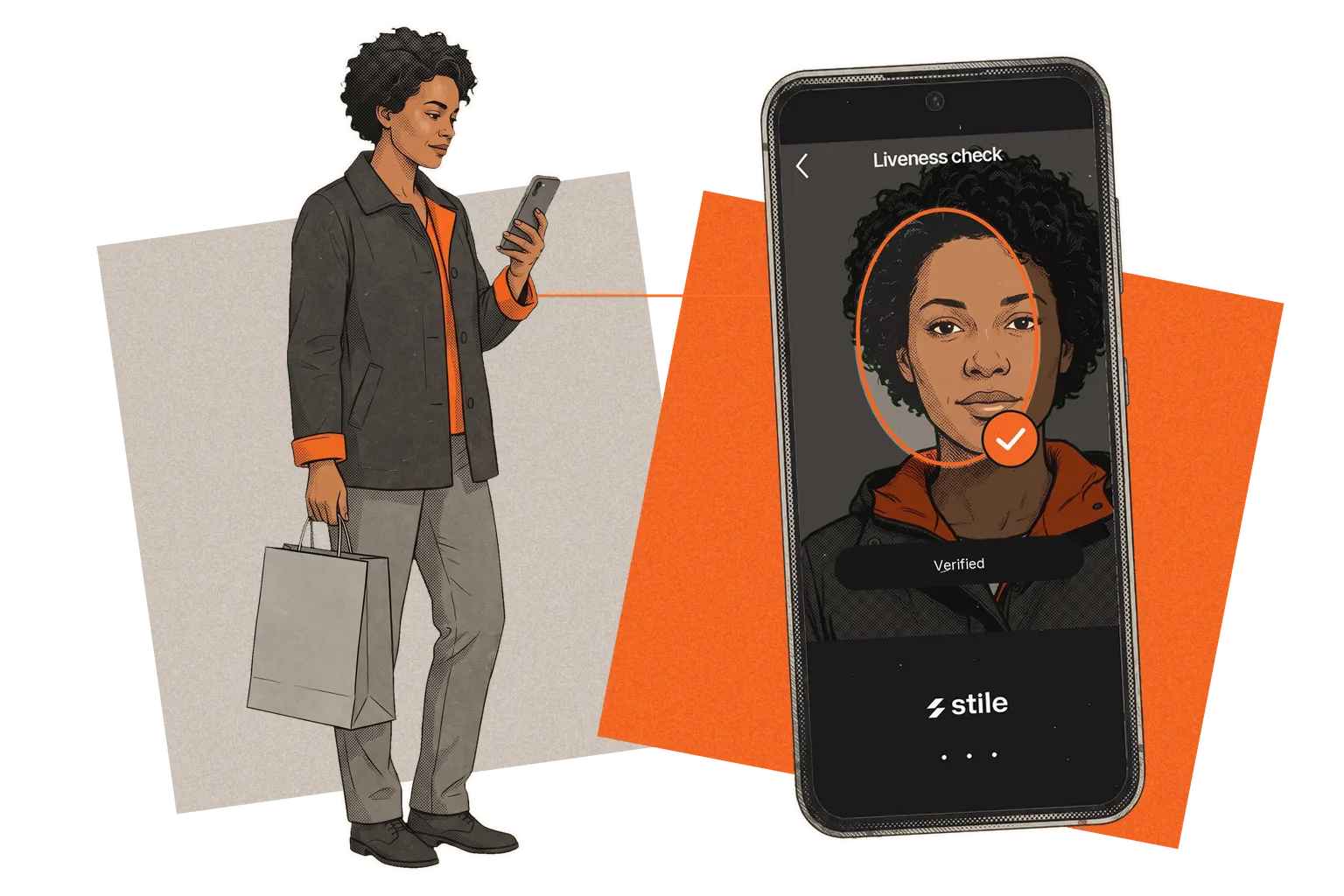
Illustration: a customer holding a paper shopping bag checks her phone. Beside her, the phone screen shows Stile's liveness check marked Verified, with her face in the oval.

Which age check methods are there?

"Age assurance" covers several methods that work in different ways. Marten Risius and Johannes Sedlmeir, writing in The Conversation, describe it as the umbrella term. Age verification, meaning proof of age usually from an official ID, is one branch of it. The methods you will see across vendors:

Document check

The user photographs a government ID. The software checks that the document is authentic and reads the date of birth.

Diagram
Full size
Illustration: a sample driver license joined by a line to a tick, the check passing.

Estimation is not proof. The Conversation authors point out that facial age estimation can make mistakes, and that it often means handing biometric data to a private company. They also describe a stronger alternative: cryptographic attestations, such as the German eID and the EU digital identity and Google wallet work, which prove a single fact like "over 18" without revealing name, address or date of birth. When you evaluate vendors, ask two questions. Which methods can fall back to a credential-backed check? And what does the vendor hand back once the check is done?

What should you compare?

  • Methods offered

    Including whether there is a step-up from estimation to document or credential.

  • What your system receives

    A decision, an age, or the raw document and selfie.

  • Retention

    How long the vendor says it keeps session data, and whether you can delete it.

  • How the user completes the check

    Hosted page, link, QR code, SDK or app.

  • Jurisdiction handling

    Whether you can set age rules by country or state.

  • Published pricing

    Per-check price, monthly minimum, and free trial.

Which to choose

Which to choose
If you needPick
Global coverage with AML in one contractSumsub or Veriff
The widest choice of methods for adults to prove ageYoti
DMV-backed matching and mobile ID at enterprise scale in the USIncode
US regulated commerce where the check runs at checkout or pickup, returns a signed result, and deletes raw ID data on completion by defaultStile

Which tool fits your business?

  • Adult content and alcohol. Volume is high, so low-friction methods matter. Check there is a step-up when estimation is close to the threshold. For US sellers, state law guides set out the bar.
  • Gambling. You usually need identity and AML screening, not just age. Sumsub's Compliance plan bundles it, and Veriff sells it as an add-on.
  • Cannabis. The check often happens twice, at online checkout and at pickup. A QR code or link covers the counter without a kiosk app.
  • Marketplaces. The risky moment is often a listing or a payout change, not signup. Pick a tool you can trigger from that action.
  • Workforce. Hiring and help-desk checks are identity checks with age as one field. Incode, Veriff and Sumsub all list this.

The figures each vendor puts on its own site

Vendors rarely state comparable numbers, so these are not a ranking. They show what each one chooses to measure.

  • Retention

    24 hours

    The most ID, selfie and session data stay after the session

    Incode

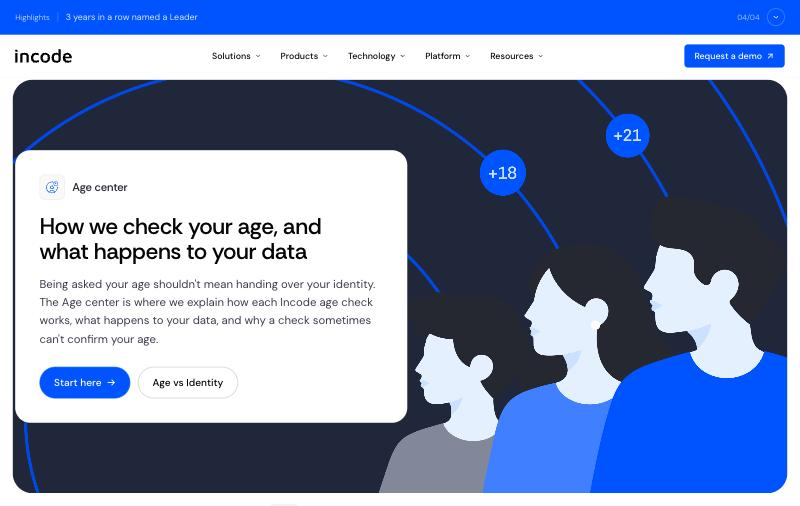
    Incode's Age Center

  • Deletion

    30 days

    To meet a deletion request

    Sumsub

    Sumsub's service privacy notice

  • Wait time

    1 second

    Check time for facial age estimation

    Yoti

    Yoti's age verification page

  • Retention

    3 to 6 months

    How long session data is kept, by plan

    Veriff

    Veriff's pricing page

  • Wait time

    ~2 seconds

    What a check is designed to take, with nothing to install

    Stile

    Stile's site

Sources

Stile wrote this comparison and is one of the five tools. Details are as each company publishes them, not independently tested, and were checked on November 1, 2026. To report a correction, email hello@stile.id.

Veriff

Best fit: teams that want estimation through document checks under one Enterprise contract, across many countries.

  • How it works: Age assurance runs in three tiers: a database check, then selfie estimation, then ID with face match for edge cases.
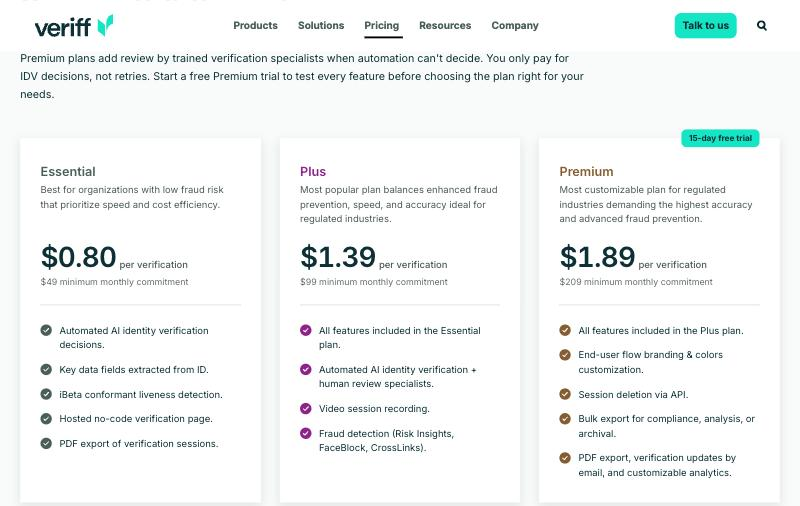
  • Data: Session data is kept 3 months on Essential and 6 on Plus and Premium, with 2 years at +$0.30 per verification. Deletion via API is Premium only. FaceBlock lists are kept 3 years, and where the law allows, Veriff may keep personal data for its own purposes. Estimation stores no biometric templates.
  • Price: $0.80 to $1.89 per verification, with $49 to $209 monthly minimums, for under 5,000 a month. Age estimation and database verification are listed under custom-priced Enterprise.
  • Trial: 15 days, 50 live verifications per plan, no credit card.
veriff.com's self-serve pricing plans

Sumsub

Best fit: regulated businesses that need age and AML checks under one plan, and operators in the German market, where KJM approval matters.

  • How it works: An ID upload with a date-of-birth check, plus optional face match and liveness. Estimation is separate, and age buffers of ±3, 7 or 10 years set when users step up.
  • Data: Clients set retention within the contract, and deletion requests are met within 30 days. Biometric limits vary, such as 3 years at most in Illinois. AML records can be kept up to 5 years.
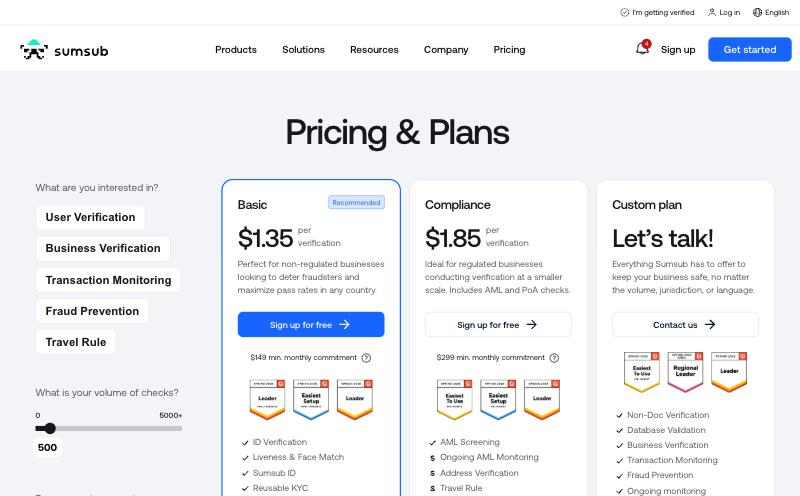
  • Price: $1.35 or $1.85 per verification, with $149 or $299 monthly minimums. Database validation is on Custom, and age estimation is on no listed plan.
  • Trial: 14 days, 50 free checks.
Sumsub's pricing plans

Incode

Best fit: US platforms that want DMV-backed biometric matching and mobile ID acceptance in one enterprise platform.

  • How it works: The Age Center explains each check to the user. Estimation can run on the device, and Digital ID accepts mobile driver's licenses, eIDs and wallets.
  • Data: ID, selfie and session data are deleted no more than 24 hours after the session, and only the age result is kept.
  • Price: Not published.
  • Also: GovFaceMatch matches biometrics against DMV records. Incode says it is a Leader in the 2026 Gartner Magic Quadrant for Identity Verification.
Incode's Age Center page

Yoti

Best fit: high-volume consumer platforms, such as social media and adult content, that want many ways for adults to pass and a result with no identity attached.

  • How it works: More methods than any other vendor here, including facial estimation, a digital ID wallet, ID with selfie, Yoti Keys, card and mobile checks.
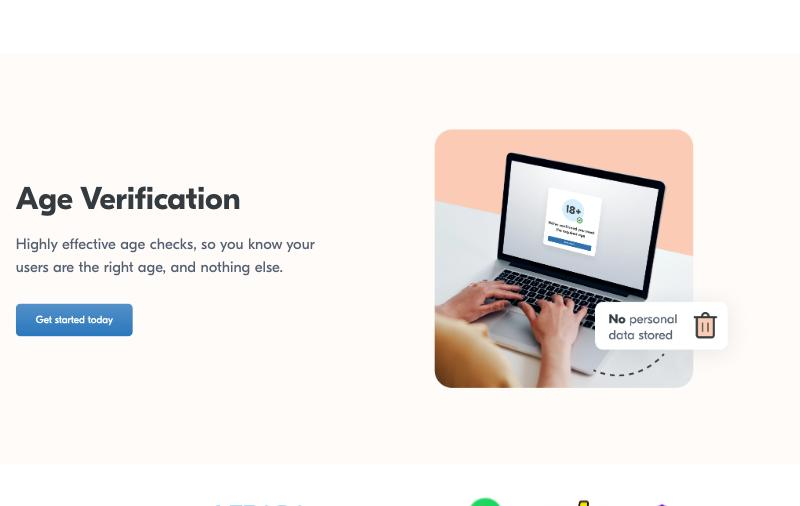
  • Data: Yoti says all data is deleted. Its privacy notice says that holds for most methods, with results stored for the client for 6 months and 28 days for a manual review.
  • Price: Not published for age checks.
  • Reported: Facial estimation takes 1 second per check, with a 99.3% true positive rate for 13 to 17 year olds estimated as under 21, as of September 2024.
Yoti's age verification page

Stile

Best fit: US regulated eCommerce and pickup, where the check has to run at a specific moment, follow state rules, and return a result rather than an ID file.

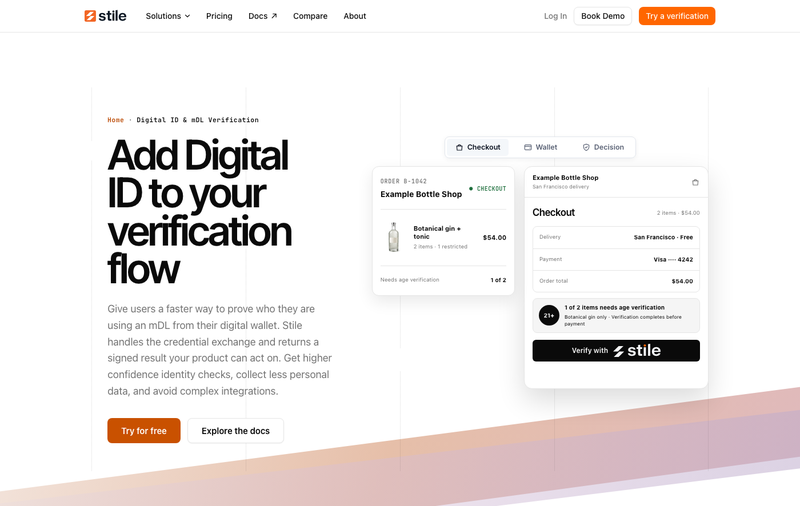
  • How it works: Start a check by API call, shared link or QR code. It opens in the browser with nothing to install and is designed to take about two seconds. See the age verification software page.
  • Data: You get a signed webhook with an audit trail. Raw ID data is deleted on completion by default, and evidence under review stays until the review resolves. The outcome and hashed anchors are kept.
  • Price: $0.21 for an ID and age check, or $0.25 for a full check that adds face match and liveness. No minimum, and the first 1,000 completed checks each month are free.
  • Limits: Stile's focus is North America, so teams that need broad international coverage should start with Veriff or Sumsub.
  • Compare further: Stile vs Yoti and Stile vs Persona.
Stile's digital ID verification page

What does age verification software cost?

Published prices run from $0.21 to $1.89 per check, and Stile, Veriff and Sumsub all publish theirs. Veriff and Sumsub add a monthly minimum, so the last column shows how many checks it would pay for. Stile has no minimum, and its first 1,000 completed checks each month are free. A Stile full check is the closest match to the Veriff and Sumsub plans here. The prices are each vendor's list prices. The division is ours.

What does age verification software cost?
PlanPrice per verificationMinimum monthly commitmentChecks the minimum covers at list price
Veriff Essential$0.80$49about 61
Veriff Plus$1.39$99about 71
Veriff Premium$1.89$209about 110
Sumsub Basic$1.35$149about 110
Sumsub Compliance$1.85$299about 161
Stile ID and age check$0.21NoneNot applicable
Stile full check$0.25NoneNot applicable

If your age gate fires a few dozen times a month, at a pickup counter or on one restricted product line, the minimum is your real price. If it fires thousands of times, the per-check rate and volume discounts matter more.

Sumsub says checks beyond the commitment are prorated. Veriff's page does not say how usage counts toward the minimum.

FAQ

Questions about age verification software

Still have a question? Book a demo

Not by default. The Conversation authors note that estimation often requires handing biometric data to a private company, and that a face cannot be changed if that data is stolen. The vendors' own answers differ. Veriff says its estimation stores no biometric templates. Yoti says data is deleted for most methods. Incode offers estimation on the device. Ask each vendor what happens to the selfie, and get the answer in writing.

Usually not. Veriff offers a hosted verification page and mobile web. Sumsub's Unilink runs from a link or QR code. Stile opens in the browser. Wallet-based methods, such as Yoti's digital ID wallet, rely on a credential the user already holds on their phone.

Yes, with less certainty. Database checks, credit card checks, mobile and email age estimation, and facial estimation all avoid a document. Veriff describes database checks and estimation as first steps before an ID is requested, and Yoti describes estimation that way. Our guide to age verification without ID covers where those methods hold up.

It varies by vendor and plan. On Veriff's pricing page, session data is kept for 3 months on Essential and 6 months on Plus and Premium, with 2 years as a paid extra; deletion via API is a Premium feature. Sumsub's clients set retention within the contract. Incode says session data is deleted no more than 24 hours after the session. Yoti says most methods delete data once the check completes, and results are stored for the client for 6 months. Stile deletes raw ID data on completion by default, and evidence under review stays until the review resolves. Whatever you choose, your own systems should store the result and the audit record, not the document.


Published self-serve prices run from $0.21 to $1.89 per check. Stile lists $0.21 for an ID and age check and $0.25 for a full check, with no minimum. Veriff runs $0.80 to $1.89 with $49 to $209 minimums. Sumsub runs $1.35 to $1.85 with $149 and $299 minimums. Veriff and Sumsub offer 50 free checks on trial, and Stile's first 1,000 completed checks each month are free. All three move to custom pricing at higher volume.

No. Incode's Age Center puts it plainly: an age check answers whether someone is old enough, and it is not an identity check. Gambling and financial products often need both. An alcohol or adult content gate usually needs only the age answer.

Try a check on your own flow

The quickest way to judge any of these tools is to run a check where your users would meet it, then look at what lands in your system afterward. With Stile, you can create a free account, and trigger an age check by link or QR code. Then check the signed webhook and confirm what your own systems store.