

Age Verification Without ID Uploads: How Private Age Checks Actually Work
New laws require age checks, but businesses do not need to collect ID scans. See how mDLs, zero-knowledge proofs, and facial estimation can verify age while minimizing personal data.
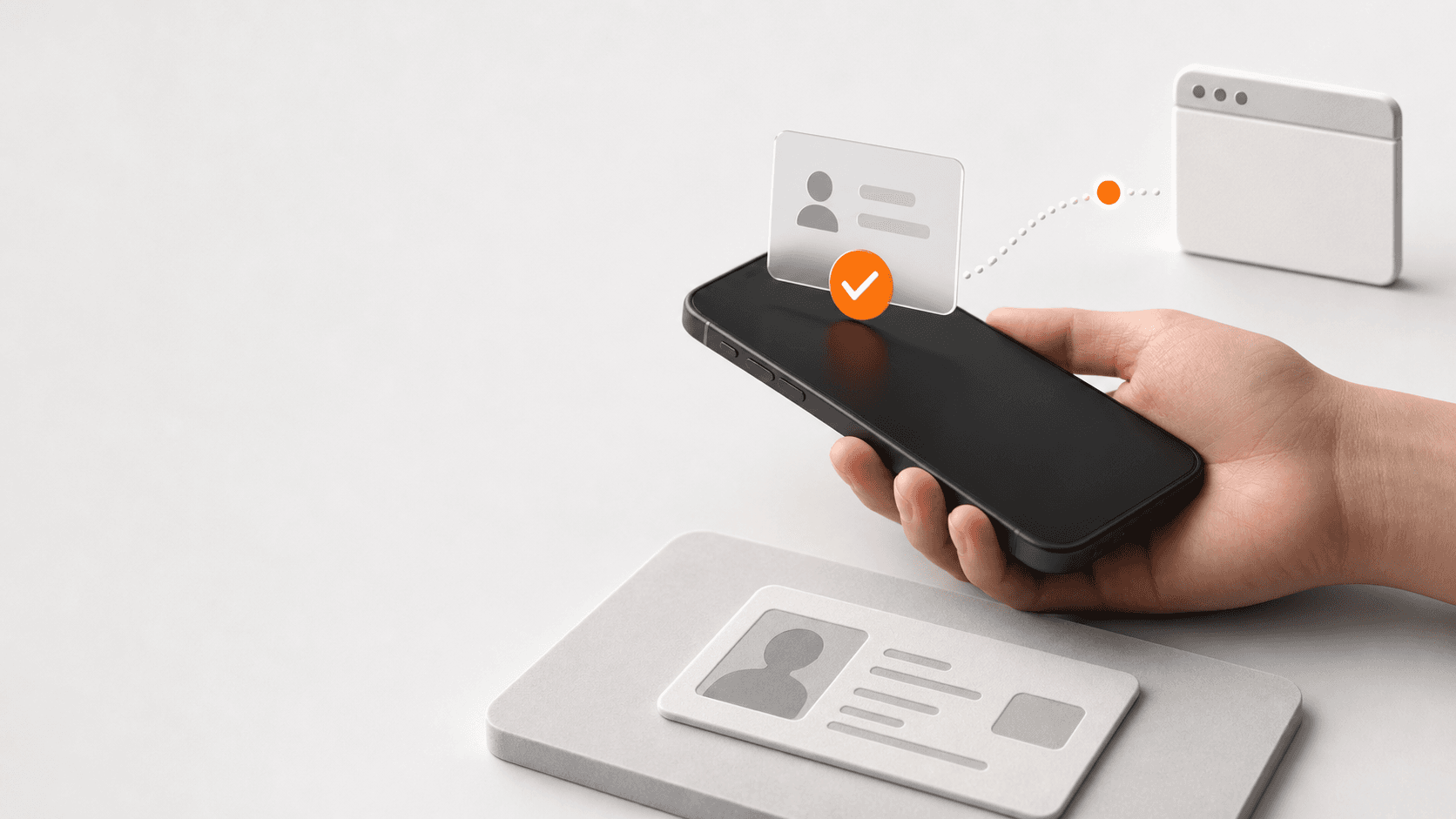
Age verification without ID uploads is not only possible in 2026, it is increasingly the approach that regulators, platforms, and users prefer. Mobile driver's licenses, zero-knowledge proofs, and facial age estimation can each confirm that someone is over 18 or 21 without an ID scan being uploaded, transmitted, or stored by the business.
That matters because the old model, photograph a driver's license and send it to a website, is breaking down on both ends. Users increasingly resist handing identity documents to every website that asks. Businesses are learning that a database of ID photos is a liability, not an asset.
There is a fraud dimension too. A document photo can be stolen, borrowed, or generated, while a cryptographically signed credential is much harder to fake. This guide explains how private age verification works, what data each method exposes, and why a privacy-first architecture can also be the stronger compliance and fraud control.
Why "upload your ID" became a liability
In October 2025, roughly 70,000 Discord users had government ID photos exposed after a third-party customer-service vendor was breached. The photos existed because users had submitted them during age-related appeals. They followed the requested process, and sensitive identity documents still became exposed.
The lesson is architectural. Every retained ID image increases the attack surface across support queues, vendor systems, backups, and internal tools. The storage cost may be low, but the consequence of exposure is not.
There is a quieter commercial cost too. Asking someone to photograph an ID in the middle of checkout can cause legitimate adults to abandon. They may be able to pass the check, but reasonably decide not to trust another company with a permanent copy of a credential.
A stored ID image is also a limited fraud control. Photo-based flows must detect stolen and highly convincing generated documents, while a state-issued wallet credential is signed at its source. Privacy-preserving methods are not a compliance compromise. They can raise assurance while shrinking the data footprint.
What "private" age verification means
A private age check answers one question: is this person over the required age? It should discard everything else. That is data minimization, collect the smallest amount of data needed to answer the compliance question and retain it for the shortest practical time.
In practice, a privacy-preserving flow has three properties:
The response is a signal, not a dossier. The business receives an over-21 decision, not a name, birthdate, address, and document photo.
Sensitive artifacts are not retained by default. No ID images, selfie stills, or extracted personally identifiable information sit in an application database.
The check does not create an identity trail. Proving age to a website should not automatically link a person's identity to their browsing or purchase history.
Each method below takes a different route to those properties.
Four ways to verify age without collecting ID scans
1. Mobile driver's licenses and digital ID wallets
A mobile driver's license (mDL) is a government-issued credential stored in a phone wallet, built on the ISO 18013-5 standard. Its defining feature is selective disclosure: the holder can share one attribute, such as over 21, without revealing a name, address, birthdate, or license number.
This inverts the document-upload model. Instead of sending a full credential and letting a verifier extract one fact, the wallet releases only that fact. The issuing authority signs the attribute, so the verifier can validate it without handling the whole license.
mDL availability is expanding across the United States. In Europe, EU Member States are required to provide European Digital Identity Wallets by the end of 2026, creating another route for citizens to present a specific age attribute rather than a copy of an identity document.
What the business sees: a signed yes-or-no attribute. What gets stored: the verification event, not the credential's personal data.
2. Zero-knowledge proofs
A zero-knowledge proof, or ZKP, proves that a statement is true without revealing why it is true. For age, a device can prove that a verified credential satisfies an age rule. The website can validate the proof without learning the person's birthdate, identity, or issuing jurisdiction.
This has moved beyond academic research. Google's open-source Longfellow ZKP libraries are designed for privacy-preserving age assurance and align with the digital-credential standards that wallets are adopting. When proofs are unlinkable, repeated checks also resist being combined into a cross-site profile.
What the business sees: a valid proof. What gets stored: nothing about the person.
3. Facial age estimation
Facial age estimation uses a short camera capture to estimate whether someone is over a threshold. No document is needed. In a privacy-preserving implementation, the capture is processed ephemerally: the system returns an over-or-under result and deletes the image on completion instead of retaining it.
Estimation has a margin of error, so a well-designed system uses an age buffer. Clear cases pass quickly, while people close to the threshold are routed to a credential-based fallback. Accuracy can also vary with lighting and demographic factors, which makes a layered flow important.
What the business sees: over or under the required threshold. What gets stored: nothing, when the capture is deleted on completion.
4. Reusable verified credentials
A reusable credential lets a user complete a strong verification once, then keep an age attestation they can present again. Each site receives the age signal without repeating document collection. This concentrates sensitive processing with the credential issuer instead of duplicating it across every merchant.
What the business sees: a signed age attestation. What gets stored: the credential stays with the user, not each website.
How the methods compare
mDL or digital ID wallet. The document remains in a wallet; the site learns an age attribute; the best fit is the highest available assurance.
Zero-knowledge proof. A verified credential is needed; the site learns only that a proof is valid; the best fit is maximum privacy and repeat checks.
Facial age estimation. No document is needed; the site learns an over-or-under result; the best fit is a fast path for people without a credential at hand.
Reusable credential. A person verifies once; the site receives a signed signal; the best fit is repeat use across services.
What the law actually requires
Age-assurance rules are expanding across adult content, alcohol, cannabis, vaping, gaming, and app stores. In 2025, the Supreme Court upheld Texas's HB 1181 in Free Speech Coalition v. Paxton. In July 2026, the Court also declined emergency requests to block Texas from enforcing its App Store Accountability Act while the underlying litigation continues.
The compliance question is not whether a business must stockpile raw ID images. It is whether its chosen method satisfies the rules that apply to that product, jurisdiction, and user. In many cases, an auditable age result and record that a compliant method was used meet the operational need without making the business a long-term custodian of identity documents.
Exact obligations vary by jurisdiction and use case. This article is a product and technology overview, not legal advice.
Offering private verification without building it yourself
For a platform or merchant, the hard part is not any one method. It is the routing: which check meets the relevant rule, what fallback serves a user without an mDL, and how to maintain completion rates while minimizing data.
That is the layer Stile provides. One integration routes a person to the strongest private method available, with digital ID and mDL verification where supported and estimation, carrier lookup, or other fallbacks where they are appropriate. Merchants receive a verification result rather than a copy of raw personal data. When a flow uses a document image or selfie, its source data follows the session's jurisdiction-specific retention rules, while the merchant still receives a decision rather than source artifacts.
The result is a faster path for legitimate users and a smaller breach surface for the business, with an audit trail that records the decision instead of a repository of identity documents.
FAQ: private age verification
Can you verify age online without an ID?
Yes. Facial age estimation can verify an over-or-under decision without a document. A mobile driver's license or verified credential can also prove an age attribute from a wallet without uploading an ID image to the website.
Do age-verification services store your ID?
Some do, particularly products built for full identity onboarding. A privacy-preserving design processes the check, returns the required signal, and avoids retaining source images or extracted personal data by default. Ask a provider what it retains, who can access it, and for how long.
Is it safe to upload an ID to a website?
It carries real risk. Safety depends on every party in the processing chain protecting and deleting data promptly. A method that does not send a document image to the business reduces that risk instead of merely managing it.
What is zero-knowledge age verification?
It is a cryptographic technique that proves an age claim, such as over 18, without revealing a birthdate or identity. The verifier learns that the claim is valid, not the underlying personal details.
How accurate is facial age estimation?
It is most useful for clear over-or-under decisions. Because estimates carry uncertainty, good systems use an age buffer and route borderline cases to a credential-based fallback.
What is the most private age-verification method?
Zero-knowledge proofs reveal the least because the verifier receives only a valid claim. mDLs with selective disclosure are a close practical alternative when wallet coverage is available.
Age verification and privacy do not have to be a trade-off. If you need to verify age this year, a well-designed flow can meet the requirement without turning every check into a new repository of ID scans.
Share this article