

 Mexico ID Guide
The IDs Mexico issues, what to check on each voter credential model, and the federal rules on age and identity checks.
- Current card design
- 2026INE voter credential, models I and J, issued since June 2026
- Older designs
- 2019 and 2014Models G and H, and E and F cards whose printed year has not passed
- Digital ID
- None to showNo digital voter credential and no wallet ID. The biometric CURP is in law
- Age-restricted sales
- 18Alcohol and tobacco. Selling vapes is banned at any age
Mexican IDs
Point at a letter, or press it, to see what to check.
Sample images: Instituto Nacional Electoral, from its guide ABC de la Credencial para Votar dated 27 Sep 2026 (images taken from the file as published), and the Secretaría de Relaciones Exteriores page Matrícula Consular de Alta Seguridad. Images were cropped to the card; nothing else was changed. No official sample of a passport data page or of a state driver's licence could be obtained, so those are described in words.
Models I and J, 2026
Current- First issued
- June 2026
- Last issued
- Still being issued
- In circulation until
- Valid for 10 years from the year of issue
- Checked
- 22 Nov 2026
Back of the card
- CIC
- The card's own number. INE lists it in the machine-readable zone, in the first line after IDMEX.
- OCR
- A 13 digit number that identifies the citizen, in the same first line.
- QR codes
- Three. Two large ones for the Valida INE-QR app and one small one for INE services.
- Barcode
- A one-dimensional barcode at the top left, with boxes beside it for marking elections.
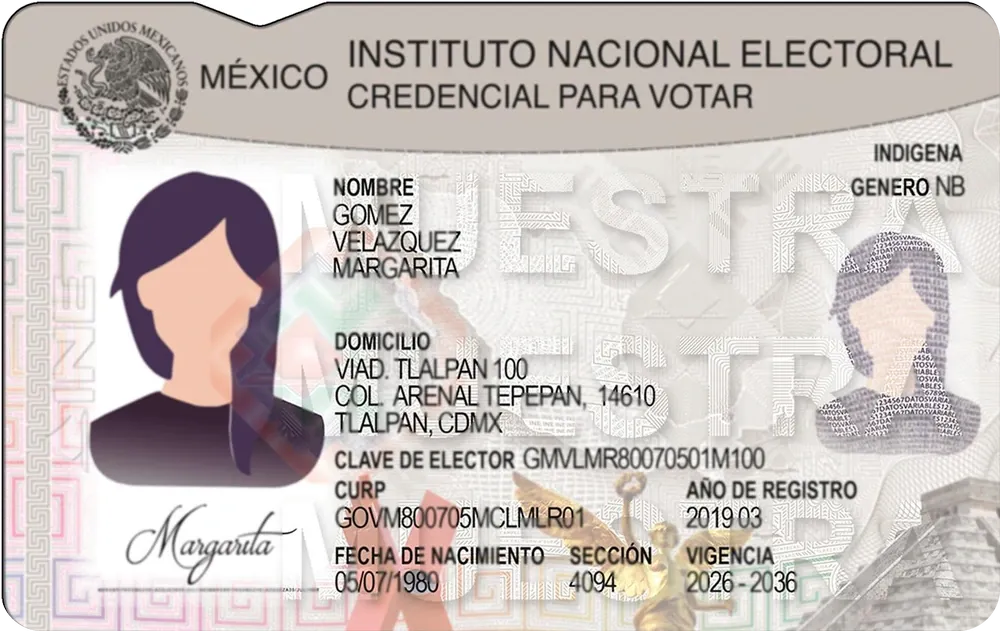
INE's guide shows this as the current model, issued from June 2026, and INE says it began producing it on 1 June 2026. The guide names the pair I and J and does not say which letter is which. In earlier pairs the first letter was the card issued in Mexico and the second the card issued abroad. Older cards stay valid until the year printed on them, so nobody has to swap. The sample has MUESTRA across the face.
What to check on the Models I and J, 2026
- A, front: Card title: CREDENCIAL PARA VOTAR. In the band at the top, under INSTITUTO NACIONAL ELECTORAL, with MÉXICO and the national coat of arms at the left. Source: INE, ABC de la Credencial para Votar (guide dated 27 Sep 2026) · checked 22 Nov 2026
- B, front: Notch in the top edge. A cut in the top edge at the left. INE says it lets a person tell the card and which way it faces by touch. Source: INE, ABC de la Credencial para Votar (guide dated 27 Sep 2026) · checked 22 Nov 2026
- C, front: Photo and signature. A colour photo at the left with the holder's signature under it. Source: INE, ABC de la Credencial para Votar (guide dated 27 Sep 2026) · checked 22 Nov 2026
- D, front: Indigenous or Afro-Mexican line, and sex or gender. At the upper right. The first line appears only if the holder asked for it. The second reads SEXO with M or H, or GENERO with M, H or NB. Source: INE, ABC de la Credencial para Votar (guide dated 27 Sep 2026) · checked 22 Nov 2026
- E, front: Address. Under DOMICILIO. The holder can ask INE to leave the street and number off the card, so some cards show less. Source: INE, ABC de la Credencial para Votar (guide dated 27 Sep 2026) · checked 22 Nov 2026
- F, front: Voter key (clave de elector). A line of 18 letters and digits after CLAVE DE ELECTOR. Source: INE, ABC de la Credencial para Votar (guide dated 27 Sep 2026) · checked 22 Nov 2026
- G, front: CURP. The 18 character population registry key, under CURP. Source: INE, ABC de la Credencial para Votar (guide dated 27 Sep 2026) · checked 22 Nov 2026
- H, front: Date of birth. Under FECHA DE NACIMIENTO at the bottom, as day, month, year. Earlier models printed it elsewhere or printed only an age. Source: INE, ABC de la Credencial para Votar (guide dated 27 Sep 2026) · checked 22 Nov 2026
- I, front: Validity (vigencia). Two years at the bottom right, for example 2026 - 2036. The card is valid through the second year. Source: INE, ABC de la Credencial para Votar (guide dated 27 Sep 2026) · checked 22 Nov 2026
- J, front: Second, faint photo. A smaller, paler copy of the photo at the right. INE says it is made up of tiny text with the holder's own data. Source: INE, ABC de la Credencial para Votar (guide dated 27 Sep 2026) · checked 22 Nov 2026
- K, back: Two large QR codes. Side by side on the back. INE's Valida INE-QR app reads them and shows the data held in them, to compare with the front. Does not prove: That the person holding the card is its owner. Compare the photo, and check the record with INE. Source: INE, ABC de la Credencial para Votar (guide dated 27 Sep 2026) · checked 22 Nov 2026
- L, back: Small QR code and colour photo. At the right of the back: a small copy of the photo in colour and a third QR code that opens INE services, including the card's standing. Source: INE, ABC de la Credencial para Votar (guide dated 27 Sep 2026) · checked 22 Nov 2026
- M, back: Three lines of machine-readable text. At the bottom of the back. The first line starts IDMEX. It carries the card number (CIC) and then the 13 digit citizen number that INE calls OCR. Does not prove: That the card is genuine. A copy can show the same print. Check the record with INE. Source: INE, ABC de la Credencial para Votar (guide dated 27 Sep 2026) · checked 22 Nov 2026
A card that passes every check is consistent with a genuine Mexican document. No visual check proves it is genuine or still valid.
Sources: INE, ABC de la Credencial para Votar (guide dated 27 Sep 2026) (opens in a new tab) · INE, Conoce el nuevo modelo de tu Credencial para Votar (8 Jun 2026) (opens in a new tab) · INE Central Electoral, new model questions and answers (7 Aug 2026) (opens in a new tab) · INE Central Electoral, CNV recommendation on credentials marked 2026 (12 Nov 2026) (opens in a new tab) · INE, Servicios (validity check description) (opens in a new tab) · INE, Lista Nominal credential check (opens in a new tab) · Ley General de Instituciones y Procedimientos Electorales, art. 156 (opens in a new tab) · SRE, Matrícula Consular de Alta Seguridad (opens in a new tab) · SRE, Pasaporte Mexicano (opens in a new tab) · SEP, Cédula profesional (opens in a new tab) · Ley General de Población, arts. 91 Bis to 91 Sexies and 114 Bis (opens in a new tab) · CRT, Lineamientos para la Identificación de Líneas Telefónicas Móviles (DOF 9 Dec 2025) (opens in a new tab) · CRT, amendment to the mobile line guidelines (approved 25 Jun 2026) (opens in a new tab) · Ley Federal de Protección de Datos Personales en Posesión de los Particulares (2025) (opens in a new tab) · Ley Federal para la Prevención e Identificación de Operaciones con Recursos de Procedencia Ilícita, art. 18 (opens in a new tab) · Código Penal Federal, arts. 243 to 246 (opens in a new tab)
How to read a Mexican ID
- VIGENCIAValid through the last year shownCurrent cards print two years, such as 2026 - 2036. Models E and F print one year. A credential lasts 10 years from the year of issue.
- SEXO or GENEROM, H, X or NBM is mujer (woman) and H is hombre (man); H is not the card model. The 2026 model prints SEXO with M or H, or GENERO with M, H or NB (non-binary). INE's guide says earlier cards could show SEXO X for non-binary from 2022; an INE note of Aug 2026 says since 2023. The holder may also have the field left off the front.
- No street addressStill a valid cardSince 2014 the holder can ask INE to keep the street and number off the front. The data stays in the codes on the back.
- Passport bookNo sample imageIssued by the foreign ministry (SRE) for 3, 6 or 10 years, or 1 year for a child under 3. The electronic passport with a chip was first issued in October 2021, as reported. Earlier books stay valid until they expire, as reported.
- CURP recordA number, not a photo IDThe CURP is an 18 character key printed on a paper or PDF record with no photo. The law of 2025 makes a CURP with photo and fingerprints the national ID, but no card was confirmed in use.
- Professional licence (cédula profesional)Now a digital documentThe education ministry (SEP) issues it as an electronic document with a QR code and no photo. Older cards with a photo exist. No sample of those was found.
- Yes, run by INEPublic validity check for the voter credentialINE describes its Lista Nominal site as a system to check a credential's validity and model, and whether it was reported lost or stolen. Our tools could not open the site itself.
- Models G, H, I and JReading the QR codesINE's Valida INE-QR app shows the data held in the two large QR codes. INE says the app does not store the data.
- Read the VIGENCIA yearOlder voter credentialsA credential is valid for 10 years. INE's guide lists models C and D and all earlier ones as no longer valid.
- Depends on the businessKeeping a copy of the IDThe anti money laundering law makes some businesses keep a copy. Mobile carriers are barred from keeping one. Everyone else needs a privacy notice and a reason.
- Treat as sensitive dataFace scans and fingerprintsThe 2025 data law asks for express written consent for sensitive data. Its list is open and does not name biometrics, so this is our reading, not the law's words.
- No national checkDriver's licencesEach of the 32 federal entities issues its own licence. No national lookup was found, and state checks were not reviewed.
How long a Mexican ID lasts
Sources: Ley General de Instituciones y Procedimientos Electorales, art. 156 (opens in a new tab) · INE, ABC de la Credencial para Votar (guide dated 27 Sep 2026) (opens in a new tab) · SRE, Pasaporte Mexicano (opens in a new tab) · SRE, Matrícula Consular de Alta Seguridad (opens in a new tab)
Digital ID in Mexico
- Digital voter credential
- Not issuedINE's General Council approved a digital strategy on 15 Jul 2025 (agreement INE/CG675/2025). It describes a Credencial Digital as a complement to the physical card, to be brought in by stages. No public release was found as of 22 Nov 2026. A photo of a card on a phone is not a credential.
- Biometric CURP
- In law, card not confirmedSince 17 Jul 2025 the law says a CURP with fingerprints and photo is the national ID, in physical and digital form. News reports through 2026 say people who enrol get a PDF by email and that enrolment is voluntary. No card or app was confirmed.
- Llave MX
- A login, not an ID to showThe federal government's sign-in for its own online services, tied to the CURP. Its guidelines call it an authentication mechanism. It is not a document a business can inspect.
- Digital driver's licences
- State by stateMexico City shows a digital licence in its city app, and news reports name the State of Mexico, Jalisco and others. The official pages could not be opened, so none of this is confirmed here.
- Apple Wallet and Google Wallet
- No Mexican IDApple's list of IDs in Wallet names no Mexican document. Google's list was not checked.
- Checking a voter credential by phone
- QR codesThe Valida INE-QR app reads the large QR codes on models G, H, I and J. The small QR code opens an INE web page with the card's standing.
Sources: INE, ABC de la Credencial para Votar (guide dated 27 Sep 2026) (opens in a new tab) · Ley General de Población, arts. 91 Bis to 91 Sexies and 114 Bis (opens in a new tab) · ATDT, Lineamientos para la implementación y operación de Llave MX (signed 27 Jan 2025) (opens in a new tab) · INE General Council, agreement INE/CG675/2025 (15 Jul 2025) (opens in a new tab) · Apple, IDs in Wallet (opens in a new tab)
Mexican law on checking age and identity
Checked 22 Nov 2026. Not legal advice.
13 laws
| Law | Who must comply | Age | What you must do | Status | Penalty |
|---|---|---|---|---|---|
| Alcohol | |||||
| Alcohol: no sales to minorsLey General de Salud, art. 220 (opens in a new tab) | Anyone who sells or supplies alcoholic drinks | 18+ | Do not sell or supply alcohol to a minor | In effectIn effect. Second paragraph added 4 Dec 2013 | Treated as the crime of corruption of minors · prosecutors and health authorities |
| Scope: All sale and supply of alcoholic drinks, anywhere in Mexico. Requires: Article 220 reads, in our translation: in no case and in no way may alcoholic drinks be sold or supplied to minors. A minor is a person under 18. ID: The article does not say how age must be checked and names no document. In practice sellers ask for an official photo ID. Many states and municipalities add their own rules on ID, licences and sale hours. Those were not reviewed for this page. Penalty: The second paragraph says a breach is treated as the crime of corruption of minors (corrupción de personas menores de dieciocho años) in the Código Penal Federal. Source: Ley General de Salud, art. 220, text as last amended 15 Jan 2026 Checked: 22 Nov 2026 | |||||
| Tobacco and vapor | |||||
| Tobacco: age 18 and a photo ID checkLey General para el Control del Tabaco, arts. 15 and 17 (opens in a new tab) | Anyone who sells, distributes or supplies tobacco products | 18+ | Ask the buyer for official photo ID to prove adulthood; without it, no sale | In effectIn effect. Law of 30 May 2008 | Fines set in multiples of the daily minimum wage · health authorities |
| Scope: Shops and anyone else who trades in tobacco products. Requires: Article 15, part II, in our translation: require the person who comes to buy tobacco products to prove they are of age with official identification with a photograph, without which the sale cannot be made. Article 17 bans selling, giving or supplying tobacco to minors, and employing minors to sell it. Sellers must also post a notice that sales to minors are banned. Accepted ID: The law says official identification with a photograph (identificación oficial con fotografía) and lists no documents. Penalty: Article 48 sets fines of 1,000 to 4,000 times the daily minimum wage for breaches of article 15 and 4,000 to 10,000 times for breaches of article 17, doubled for a repeat. The unit now used to calculate these fines was not checked. Source: Ley General para el Control del Tabaco, text as last amended 17 Feb 2022 Checked: 22 Nov 2026 | |||||
| Tobacco: no online, phone or mail sales, no vending machinesLey General para el Control del Tabaco, art. 16 (opens in a new tab) | Anyone selling tobacco to consumers | All ages | Do not sell tobacco to consumers by internet, phone or mail, or from a machine | In effectIn effect | Fines of 1,000 to 4,000 times the daily minimum wage · health authorities |
| Scope: Sales to the final consumer. Requires: Article 16 bans selling any tobacco product to the final consumer by telephone, mail, internet or any other means of communication (part IV), selling from vending machines (part III), placing cigarettes where a customer can take them directly (part II), and selling single cigarettes (part I). For online sellers: There is no age check that makes an online tobacco sale lawful. The sale itself is banned. Source: Ley General para el Control del Tabaco, art. 16 Checked: 22 Nov 2026 | |||||
| Vapes and e-cigarettes: constitutional mandateConstitución Política, arts. 4 and 5 (DOF 17 Jan 2025) (opens in a new tab) | Congress and everyone in the vape trade | All ages | No duty on its own; it orders the law to punish the trade | In effectIn the Constitution since 17 Jan 2025 | None in the Constitution itself |
| Scope: Article 4 now says, in our translation: to guarantee the right to health protection, the law shall punish all activity related to electronic cigarettes, vapes and other similar systems or devices that the law names. A matching paragraph was added to article 5 on the same day. Effect: This is the basis for the ban in the Ley General de Salud, listed next. Source: Constitución Política de los Estados Unidos Mexicanos, text as last amended 7 Oct 2026 Checked: 22 Nov 2026 | |||||
| Vapes and e-cigarettes: nationwide ban on saleLey General de Salud, arts. 282 Ter to 282 Quinquies and 456 Bis (DOF 15 Jan 2026) (opens in a new tab) | Anyone who makes, imports, stores, transports, distributes, sells, supplies or advertises vapes | All ages | Do not sell, supply or advertise vapes or e-cigarettes to anyone | In effectPublished 15 Jan 2026; in force since 16 Jan 2026 | 1 to 8 years in prison and a fine of 100 to 2,000 UMA · health authorities and prosecutors |
| Scope: Electronic cigarettes, vapes and similar devices, with or without nicotine, including disposable ones. Requires: Article 282 Quater bans buying for resale, making, importing, exporting, storing, transporting for trade, distributing, selling and supplying them, and bans all advertising in any medium, including digital. Not banned: The same article exempts use and possession that is not for those purposes. For sellers: There is no legal age for buying a vape in Mexico. An age check does not make a sale lawful. Penalty: Article 456 Bis: 1 to 8 years in prison and a fine of 100 to 2,000 times the daily UMA (the unit Mexico uses to set fines). Dates: The articles are marked as added on 15 Jan 2026. The decree's first transitional article, printed at the end of the consolidated text, says it enters into force the day after publication, which is 16 Jan 2026. Source: Ley General de Salud, text as last amended 15 Jan 2026 Checked: 22 Nov 2026 | |||||
| Online gambling | |||||
| Betting and gaming: no minorsLey Federal de Juegos y Sorteos · Reglamento, arts. 5, 9 and 85 (opens in a new tab) | Holders of a federal betting or gaming permit, including those taking bets online | 18+ | Keep minors out of betting areas and never take a bet from a minor | In effectLaw of 31 Dec 1947; regulation last amended 16 Nov 2023 | Closure of unlicensed venues and other penalties · interior ministry (Secretaría de Gobernación) |
| Scope: Betting and gaming need a permit from the interior ministry. The 1947 law says nothing about the internet. Its regulation lets permit holders take bets by internet, phone or electronic means (article 85). Requires: Article 5 of the regulation bars minors from betting areas, except at live shows with an adult, and says, in our translation: in no case may minors take part in betting. Article 9 requires advertising to say that betting is prohibited for minors. ID: For bets taken by internet, phone or electronic means, article 85, part I, requires the operator's control system to record the account number and identity of the bettor, and the interior ministry must approve the betting mechanics beforehand. The regulation does not say which document proves identity or age. Casinos and betting firms are also covered by the anti money laundering law, listed under Scanning IDs. Reform: Several bills for a new gaming law are before Congress. None has passed. Source: Ley Federal de Juegos y Sorteos (https://www.diputados.gob.mx/LeyesBiblio/pdf/109.pdf) and its regulation Checked: 22 Nov 2026 | |||||
| Cannabis | |||||
| Cannabis: personal use by permit, no legal salesLey General de Salud, arts. 235, 247 and 479 · SCJN Declaratoria General de Inconstitucionalidad 1/2018 (opens in a new tab) | Adults who want to use cannabis, and anyone who would sell it | Adults | Do not sell: there is no licensed retail market for adult use | In effectCourt ruling published 15 Jul 2021Court: Supreme Court (SCJN), general declaration 1/2018, notified 29 Jun 2021: struck the words limiting cannabis to medical and scientific use | Drug offences in the health law and the federal penal code · prosecutors |
| What the court did: The Supreme Court struck from articles 235 and 247 the words that allowed these acts only for medical and scientific purposes, because the health ministry was barred from authorising personal recreational use of cannabis and THC. What that means: A person may ask the health regulator for a permit for personal use. The ruling did not create shops, licences to sell, or a purchase age for retailers to check. Selling remains an offence. Possession: Article 479 treats up to 5 grams of cannabis as personal and immediate use. Congress: No federal law regulating an adult-use market has been enacted. The current state of the bills was not confirmed. Not confirmed: That the permits are limited to adults was not re-read in the ruling for this page. Source: Ley General de Salud, with the declaration's operative points printed at the end of the consolidated text Checked: 22 Nov 2026 | |||||
| Social media | |||||
| Online platforms: age checks to protect minors (executive decree)Decreto de entornos digitales seguros para niñas, niños y adolescentes (DOF 14 Oct 2026) (opens in a new tab) | Digital platforms, including social networks, video games and app stores | Under 18 | Use reliable age checks that go beyond self-declaration, and keep harmful content from minors | In effectExecutive decree in force since 14 Oct 2026. No fines, no regulator named, untested | None: the decree sets no fines and names no regulator |
| What it is: A decree of the President, not an act of Congress. It rests on articles 101 Bis 2 and 101 Bis 3 of the general law on children's rights. Who: Any internet intermediary service that lets users interact or share content. The decree names social networks, video games and app stores, among others. It sets no size threshold. Age checks: Article 4, part I, in our translation: implement reliable and secure mechanisms to identify the age of the users of their services. These mechanisms must not be limited to the users' own declaration. No method is named. Other duties: Do not let minors reach or be recommended content on harassment, sexual abuse or exploitation, hate or mass violence, crime, pornography and sexually explicit material, suicide, self-harm or eating disorders. Publish age rating and moderation rules, remove such accounts and content at once, offer reporting tools and parental supervision, turn on the strictest privacy settings by default, assess risks, keep evidence of removed content for at least 90 working days, and name a contact for the authorities available at all hours. Deadline: Platforms had to document and report their measures within 30 calendar days of 14 Oct 2026. The decree does not say to whom. Limits: The decree sets no fines and names no regulator. It orders a working group to draft further regulation. Whether a decree can bind private platforms without a statute has not been tested in court, as far as we found. Source: Diario Oficial de la Federación, 14 Oct 2026, read in full Checked: 22 Nov 2026 | |||||
| Scanning IDs | |||||
| Biometric CURP as the national IDLey General de Población, arts. 91 Bis to 91 Sexies and 114 Bis (DOF 16 Jul 2025) (opens in a new tab) | Every public body and private business that offers a service or procedure | All ages | Ask for the CURP in procedures and services, and accept the biometric CURP as ID | In effectIn force since 17 Jul 2025; enrolment still under way | Fines of 10,000 to 20,000 UMA after a warning · interior ministry |
| What it says: Article 91 Bis, in our translation: the CURP that also contains fingerprints and a photograph shall be the mandatory national identification document, universally and compulsorily accepted throughout the national territory, and shall be available in physical and digital format. Consent: Biometric data is added only with the holder's prior consent. Businesses: Article 91 Sexies says every public or private body must ask for the CURP to provide its procedures and services. The transitional articles gave 90 calendar days to adapt. Digital version: The digital CURP as identification is the job of the federal digital agency (ATDT). A single identity platform is to validate CURPs. Penalty: Article 114 Bis: authorities and private parties that repeatedly fail the duties in article 91 Bis, after a warning, are fined 10,000 to 20,000 times the daily UMA. State of play: The law names no date by which every person must enrol. News reports through 2026 say the population registry calls enrolment voluntary and gradual, and that no card is handed out. That was not confirmed on an official page. A bill to postpone registration, reported as referred to committee in March 2026, has not become law: the consolidated text still shows its last reform as 16 Jul 2025. Source: Ley General de Población, consolidated text Checked: 22 Nov 2026 | |||||
| Personal data held by businesses (2025 law)Ley Federal de Protección de Datos Personales en Posesión de los Particulares (DOF 20 Mar 2025) (opens in a new tab) | Any private person or business that handles personal data | All ages | Give a privacy notice, collect only what the purpose needs, and delete data once it is no longer needed | In effectIn force since 21 Mar 2025; last amended 14 Nov 2025 | Fines up to 320,000 UMA, which can double for sensitive data · Secretaría Anticorrupción y Buen Gobierno |
| What changed: This law replaced the 2010 law of the same name. The independent data authority was dissolved and its powers passed to a ministry, the Secretaría Anticorrupción y Buen Gobierno. Copies of IDs: An ID copy is personal data. The business needs a privacy notice and a stated purpose. Article 10 says data that is no longer needed for that purpose must be deleted after blocking. Sensitive data: Article 8 requires express written consent, by signature, electronic signature or another authentication mechanism, and bars building databases of sensitive data without a justified purpose. The definition lists racial or ethnic origin, health, genetic information, beliefs, political opinions and sexual preference, and says the list is not closed. It does not name biometric data. Treating face scans and fingerprints as sensitive is our reading. Penalty: Fines of 100 to 160,000 or 200 to 320,000 times the UMA depending on the breach, with a further fine for repeats, and up to twice the amounts where sensitive data is involved. Articles 62 to 64 add prison terms for certain breaches. Source: consolidated text, last reform 14 Nov 2025 Checked: 22 Nov 2026 | |||||
| Mobile lines must be linked to an identified personLey en Materia de Telecomunicaciones y Radiodifusión, art. 103 · CRT guidelines (DOF 9 Dec 2025) (opens in a new tab) | Mobile carriers and resellers | All ages | Activate and keep active only lines linked to a person who showed official ID with a CURP | In effectLaw of 16 Jul 2025. Unlinked lines are being cut off through 31 Dec 2026 | Loss of service for the line · Comisión Reguladora de Telecomunicaciones (CRT) |
| Requires: Article 103: carriers may activate and keep active only lines tied to end users who presented official ID. For individuals the ID must contain the CURP; for companies, the tax number (RFC). Foreigners may identify with name, country and passport number. Accepted ID: The CRT guidelines define official ID as a document issued by a federal authority with CURP and photograph, and list three: the INE voter credential, the passport, and the national identification document issued by the population registry. Data: Carriers validate the ID against official sources. Articles 34 and 44 of the guidelines bar them from keeping any biometric data, photograph or copy of the ID. Dates: Carriers had 30 days from 9 Dec 2025 to start linking lines. The original cut-off for unlinked lines was 30 Jun 2026. On 25 Jun 2026 the CRT replaced it with a calendar by the last digit of the number: 0 on 15 Aug 2026, 1 on 31 Aug 2026, and so on, on the 15th and the last day of each month, ending with 9 on 31 Dec 2026. Service is disabled within 72 hours of each date. Emergency calls still work. Source: the law (https://www.diputados.gob.mx/LeyesBiblio/pdf/LMTR.pdf), the guidelines (https://sidof.segob.gob.mx/notas/docFuente/5775677) and their amendment (https://sidof.segob.gob.mx/notas/docFuente/5792297) Checked: 22 Nov 2026 | |||||
| Anti money laundering: identify the customer and keep a copyLey Federal para la Prevención e Identificación de Operaciones con Recursos de Procedencia Ilícita, arts. 17 and 18 (opens in a new tab) | Businesses that carry out a listed vulnerable activity, such as betting and gaming, and others the law lists | All ages | Identify the customer directly, verify the ID against official documents and keep a copy | In effectLaw of 17 Oct 2012; article 18 amended 16 Jul 2025 | Administrative fines · finance ministry (Secretaría de Hacienda) |
| Requires: Article 18, part I, in our translation: identify and know directly the customers or users with whom they carry out the vulnerable activity and verify their identity based on documents or other means of identification with official recognition, and obtain a copy of them, under the general rules the ministry issues. Also: Ask about the customer's occupation where there is a business relationship, identify the controlling beneficiary, and keep the supporting records. Which documents: The law leaves the list of accepted documents to the ministry's general rules. Those rules were not read for this page. Banks: Banks and other financial firms follow their own sector rules, which were not reviewed. Source: consolidated text, last reform 16 Jul 2025 Checked: 22 Nov 2026 | |||||
| Forged and altered documentsCódigo Penal Federal, arts. 243 to 246 (opens in a new tab) | Anyone who forges or alters a document, or knowingly uses a forged one | All ages | Do not forge or alter a document, and do not knowingly use a forged one | In effectIn effect | 4 to 8 years in prison and 200 to 360 day-fines for public documents · federal prosecutors |
| Offence: Forgery of documents (falsificación de documentos). Article 244 lists the ways it is committed, starting with a false signature or altering a true one. Penalty: Article 243: for public documents, 4 to 8 years in prison and 200 to 360 day-fines. For private documents, 6 months to 5 years and 180 to 360 day-fines. The penalty rises by up to half if a public servant commits it. Voter credentials: A separate law on electoral crimes also covers altering the electoral roll and credentials. It was not read for this page. Use: Article 246, part VIII, applies the same penalty to a person who knowingly uses a false document or a copy of one. For sellers: These articles put no duty on a business shown a forged document. No federal rule was found that lets a seller keep a customer's suspected fake ID. Source: Código Penal Federal, text as last amended 13 Mar 2026 Checked: 22 Nov 2026 | |||||
This page lists Mexican federal law only, including one presidential decree. The 32 federal entities and their municipalities set their own rules, for example on alcohol licences, sale hours and ID at the door; those were not reviewed. There is no federal statute on age verification for adult websites or social media. Bills before Congress would set a minimum age for social media, replace the 1947 gaming law, regulate adult-use cannabis and postpone biometric CURP registration; none has become law.
Timeline
- 6 Jun 2027Upcoming · Voter credentialFederal election day. INE's oversight commission has proposed that credentials marked 2026 stay valid until this date; the General Council has not been confirmed to have approved it
- 1 Jan 2027Upcoming · Voter credentialCredentials whose validity ends in 2026 stop being valid, unless INE's General Council extends them
- 31 Dec 2026Upcoming · Mobile linesLast date in the regulator's calendar: unlinked mobile numbers ending in 9 lose service
- 14 Oct 2026Effective · Social mediaPresidential decree on safe digital environments takes effect: it tells platforms to check age by more than self-declaration, with no fines and no regulator named; untested
- 15 Aug 2026Effective · Mobile linesCarriers begin disabling mobile lines not linked to an identified person, starting with numbers ending in 0
- Jul 2026Bill pending · Social mediaBills to set a minimum age for social media are introduced in the Chamber of Deputies (reported); none has passed
- 1 Jun 2026New design · Voter credentialINE begins producing the current voter credential, models I and J
- 15 Jan 2026Effective · Tobacco and vaporBan on making, importing, selling and advertising vapes is published in the health law
- 9 Dec 2025Effective · Mobile linesTelecom regulator publishes the rules for linking every mobile line to an ID with a CURP
- 16 Jul 2025Effective · CURPReform makes the CURP with photo and fingerprints the national ID; a new telecom law and anti money laundering changes are published the same day
- 15 Jul 2021Court · CannabisSupreme Court's general declaration on personal cannabis use is published
- Dec 2019New design · Voter credentialINE begins issuing models G and H, with QR codes on the back
Questions
Still have a question? Book a demo
Read the VIGENCIA on the front. A credential lasts 10 years from the year of issue and is valid through the last year printed. Today that means the 2026 model, models G and H of 2019, and those model E and F cards that show 2026 or later.
INE's guide lists models C and D, and everything before them, as no longer valid. Cards marked 2026 run out on 31 Dec 2026 unless INE's General Council extends them; its oversight commission has recommended 6 Jun 2027.
INE runs a public site, the Lista Nominal check, which it describes as a system to verify a credential's validity and model and to see whether it was reported lost or stolen. On models G, H, I and J the Valida INE-QR app reads the two large QR codes so you can compare them with the front.
Neither check proves that the person in front of you is the card's owner. Compare the photo, and for higher risk use a check that matches the face to the document.
It is widely accepted in practice, and the tobacco law only asks for official identification with a photograph. But licences are issued by each of the 32 federal entities, the designs differ, and there is no national lookup.
Some rules are narrower. To link a mobile line, the regulator accepts only the INE credential, the passport and the national identification document. This page shows no licence because no official sample could be obtained.
The law has said since 17 Jul 2025 that a CURP with fingerprints and photo is the mandatory national ID and must be accepted everywhere. Authorities and private parties that repeatedly fail the duties in article 91 Bis can be fined, but only after a warning.
The law sets no date by which each person must enrol, and biometric data is added only with consent. News reports say enrolment is voluntary in 2026 and that no physical card is handed out. Do not turn a customer away for lacking one.
It depends on what you are. Businesses under the anti money laundering law must verify identity and keep a copy. Mobile carriers must not keep a copy, a photo or any biometric data when linking a line.
Everyone else needs a privacy notice, a stated purpose, and a plan to delete the data when it is no longer needed. For face scans and fingerprints, get express written consent.
The age is 18. For tobacco the law tells the seller to ask for official photo ID and bans online, phone and mail sales outright. For alcohol the federal law bans sales to minors but does not say how to check; states and municipalities add their own rules.
Vapes are different. Since January 2026 selling or advertising them is a crime at any age, so there is nothing to verify. Online, an executive decree of 14 Oct 2026 tells platforms to check age by more than self-declaration. It sets no fines, names no regulator and is untested, so treat it as a direction and not as a duty with set consequences.
Check IDs with Stile
See which documents and checks Stile supports today.