

Buyer's guide
Persona Alternatives for High-Risk Workflows (2026)
Most teams searching for a Persona alternative start with onboarding: which vendor verifies a new user better, in more countries, with less engineering. That question is real, but it is half the problem.
At a glance
If the trouble starts after signup, the onboarding vendor is not the problem.
- Onboarding problems
- Trulioo, Jumio or Alloy
- Face or iris biometrics
- iProov or Iris ID
- A payment change, recovery request or pickup
- Stile
Compared on what each site said on November 1, 2026. Sources follow the tables below.
The risk comes after signup
A person who passed KYC at signup last year is not proof of who is changing the payout details today. The fraud that hurts marketplaces, payment platforms and logistics networks tends to happen later, at a payment change, an account recovery request or a high-value pickup. Choose an alternative by asking what it can verify at that moment, not only at the front door.
This page compares five tools that come up as Persona alternatives (Trulioo, Jumio, Alloy, iProov and Iris ID), plus Stile, on what each one says it does on its own site.
Who this comparison is for
It is written for developers, product teams and compliance or security leads who already run some form of identity verification and are reconsidering it. Usually one of three things has happened:
- Onboarding works, but account takeover, payout fraud or vendor impersonation is getting through after signup.
- The current flow adds friction users abandon, such as an app download or a long capture step.
- The team wants a different vendor model: broader data coverage, an orchestration layer, or a lighter API it can call from anywhere.
AiPrise's Persona alternatives guide frames the main trade-off as control versus completeness: a composable toolkit your engineers assemble and maintain, or a platform that covers more out of the box. That framing helps for onboarding programs. For high-risk workflows a third question matters as much: can the check fire in the middle of a workflow, for a user who is already logged in, without sending them somewhere new?
What to compare
What to compare when replacing Persona
Use these six criteria. Each one maps to a question you can put to a vendor in a demo or test in a trial.

When the check runs
Signup only, or on demand at any step? Can you trigger it from an API call, a link in an email or SMS, or a QR code at a counter?

What the user has to install
A native app or SDK inside your app, or a browser page that opens on the phone they already hold?

What a full check covers
Document capture, liveness, face match, mobile driver's licenses and wallet credentials, age checks. Name the ones your workflows need.

What comes back to your system
A pass or fail with evidence you can audit, or raw document images you now have to store and protect?

How it fits your stack
Does it replace your onboarding, compliance and fraud systems, or feed a result into the system that already makes the decision?

How you pay and how you start
A self-serve account you can test today, or a demo and contract first? Usage-based, or a commitment sized to a guess about volume?
At a glance
| Tool | What its own site leads with | Checks and capabilities its site names | Where it is aimed | How its site asks you to start |
|---|---|---|---|---|
| Trulioo | Global identity verification and risk intelligence for businesses, people and AI agents | Person verification (KYC), document verification, eID, age assurance, KYB, UBO discovery, AML screening, device intelligence, agent verification (KYA) | Banking, crypto, forex, gaming, marketplaces, payments, remittances, wealth management | Talk to sales |
| Jumio | Identity intelligence across the customer lifecycle, not a single point-in-time check | Biometrics, identity verification, risk signals, AML screening, selfie.DONE reusable identity | Onboarding and ongoing trust across the customer lifecycle | Get started or contact sales |
| Alloy | Full-lifecycle financial crime intelligence | Orchestration and decisioning engine, identity verification, fraud management, KYC/KYB, AML screening, step-up verification, transaction monitoring | Banks, credit unions, fintechs, sponsor banks, crypto | Schedule a demo |
| iProov | Science-based biometrics to onboard and authenticate users in seconds | Biometric capture, matching, liveness detection, authentication, account recovery and device rebinding | Financial services, government, healthcare, travel and borders, workforce | Contact us or request a demo |
| Iris ID | Iris recognition identity | Iris recognition hardware (IrisAccess, iCAM series), software (iAMS, iTMS, iData Iris SDK) | Access control, time and attendance, national identity, law enforcement, transportation and immigration | Contact us |
| Stile | Verify the person behind the action at the point of action | Document capture, liveness, face match, mDL and Apple/Google Wallet credentials, age checks, signed webhooks with audit trail | Marketplaces, payment changes, account recovery, age-restricted checkout or pickup, logistics vendor onboarding | Free account with an API key in minutes |
The figures each vendor puts on its own site
Vendors rarely state comparable numbers. These are the ones each site does state, so you can see what each one chooses to measure.
| Tool | Figure | What it measures | Source |
|---|---|---|---|
| Trulioo | 450+ independent data partners | Breadth of data used for individual verification | Trulioo's solutions page |
| Alloy | 300+ data solutions | Size of its vendor-neutral data partner ecosystem | Alloy's UK homepage |
| Jumio | 120 transactions per second | Processing throughput | Jumio's homepage |
| iProov | "In seconds" | Time to onboard or authenticate a user | iProov's homepage |
| Stile | About two seconds | Time for a check, with nothing to install | Stile's site |
Two of these measure coverage, one measures throughput, and two measure the user's wait. Coverage matters most when you onboard strangers across many countries. Wait time matters most when the check interrupts someone who is already mid-task and can walk away.
Sources
- Trulioo: homepage, solutions page and integrations page.
- Jumio: homepage.
- Alloy: UK homepage.
- iProov: homepage and account recovery post.
- Iris ID: homepage and contact page.
- AiPrise: Persona alternatives guide.
- Each site checked November 1, 2026.
Trulioo
Trulioo positions itself as a global identity and risk platform. Its homepage headline is "Understand Every Business. Understand Every Person. Understand Every AI Agent." Its product menu runs from person verification, document verification and electronic identity verification (eID) to business verification, UBO discovery, AML screening, device intelligence and agent verification (KYA).
Trulioo's solutions page says its individual verification draws on more than 450 independent data partners. It says onboarding workflows can launch through the Trulioo API or a no-code/low-code hosted user interface, and integrations cover MCP, APIs and SDKs. Its fraud intelligence combines consortium data, risk indicators and machine learning. The site lists SOC 2 Type II and ISO 27001:2022.
The same page carries the line "One End-to-End Platform, One Contract", and the site directs buyers to talk to sales.
Fits when: you onboard people and businesses across many countries, KYB and beneficial-ownership checks are core to your program, and you want one contract covering both.
Jumio
Jumio's homepage makes an argument close to the one this page opens with: "Identity isn't a single moment." It says it goes "beyond point-in-time identity verification checks" to deliver continuous, contextual identity insights throughout the customer lifecycle, drawing on what it calls the Jumio Identity Graph.
Its solutions menu covers biometrics, identity verification, risk signals and AML screening. Its reusable identity product, selfie.DONE, is described as recognizing trusted users "with just a selfie." Jumio states it processes 120 transactions per second, and its site offers a TCO calculator and a showcase app for evaluation.
Fits when: you run high-volume identity verification and want one vendor for onboarding, re-recognition of returning users, and watchlist screening.

Alloy
Alloy's UK site describes it as "full-lifecycle financial crime intelligence." Its core is an orchestration and decisioning engine that routes inputs, sequences vendor calls and manages dependencies, sitting on a vendor-neutral ecosystem of 300+ data solutions.
Its use cases go well past onboarding: account takeover fraud, money muling, scams, synthetic identity fraud, risk-based authentication, step-up verification management, external account ownership and transaction monitoring across ACH, RTP/FedNow, wire and stablecoin. The site lists banks, credit unions, fintechs, sponsor banks and crypto companies as the teams it works with.
Fits when: you are a financial institution that wants one engine to combine several data vendors and fraud signals into a single decision, across the whole account lifecycle.

iProov
iProov focuses on biometrics: capture, matching and liveness for remote onboarding and authentication. Its homepage promises to "onboard and authenticate your users in seconds with science-based biometrics."
Its use cases include account recovery and device rebinding, multi-factor authentication, digital identity, and visas, borders and immigration. It also runs a workforce suite that covers account recovery, and a separate physical access suite. iProov's blog features a post arguing that the account recovery process is the weak link that social engineering exploits, which is the same post-signup moment this comparison is concerned with. Its site lists financial services, government, healthcare and travel as industries.
Fits when: your main need is face-based liveness and authentication, including at recovery and device changes, in regulated or government settings.

Iris ID
Iris ID builds iris recognition. Its site is organized around hardware (the IrisAccess iA1000, the iCAM series, the IrisTime iT100) and software such as iAMS, iTMS and the iData Iris SDK. Its solutions cover access control, time and attendance, national identity, data centers, law enforcement, public safety and justice, and transportation and immigration.
That makes it a different kind of alternative from the others here. It is built for places where a person stands at an installed reader, not for a check that opens on a customer's phone.
Fits when: you control the physical location and need biometric access or attendance at a door, desk or border point.
Stile
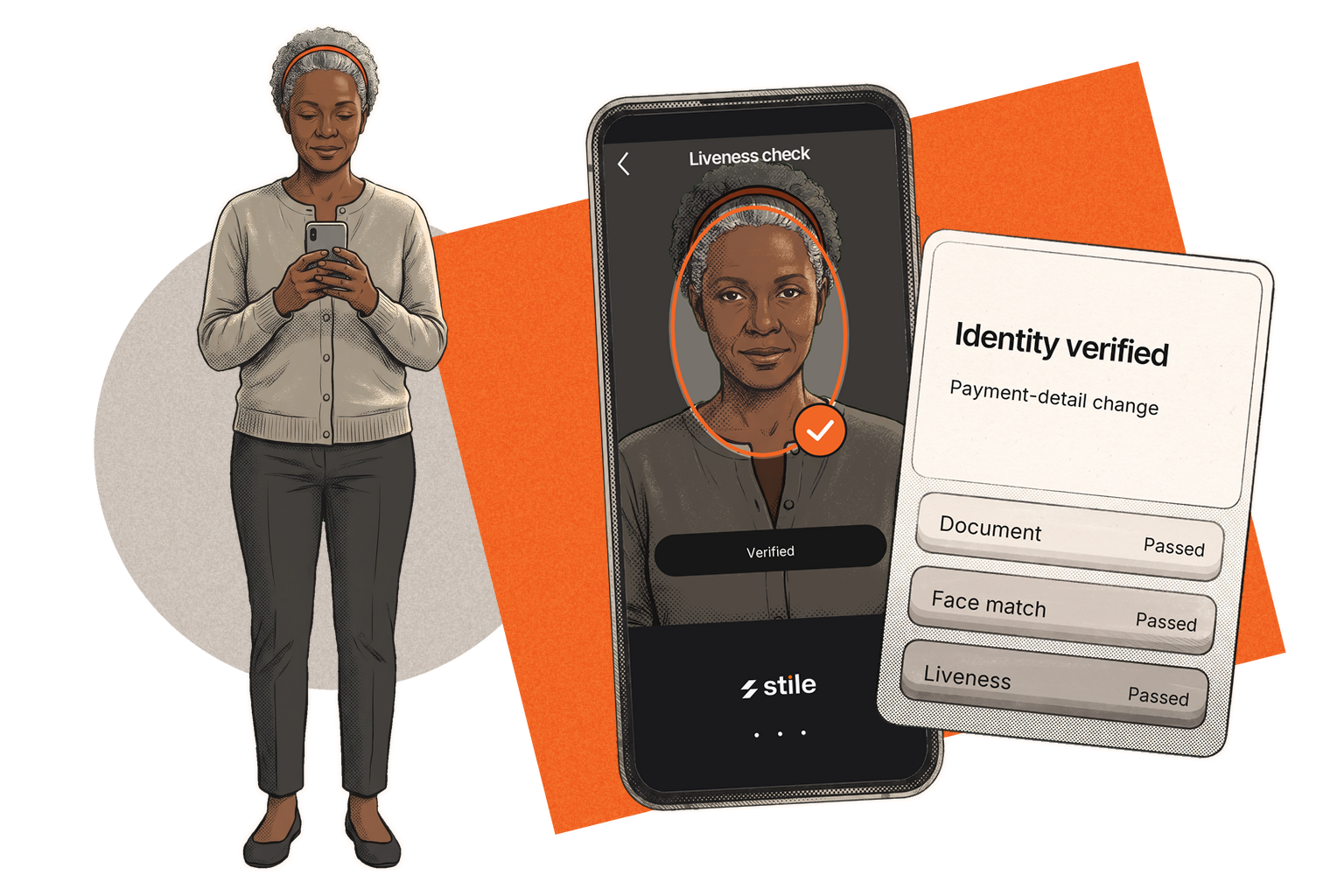
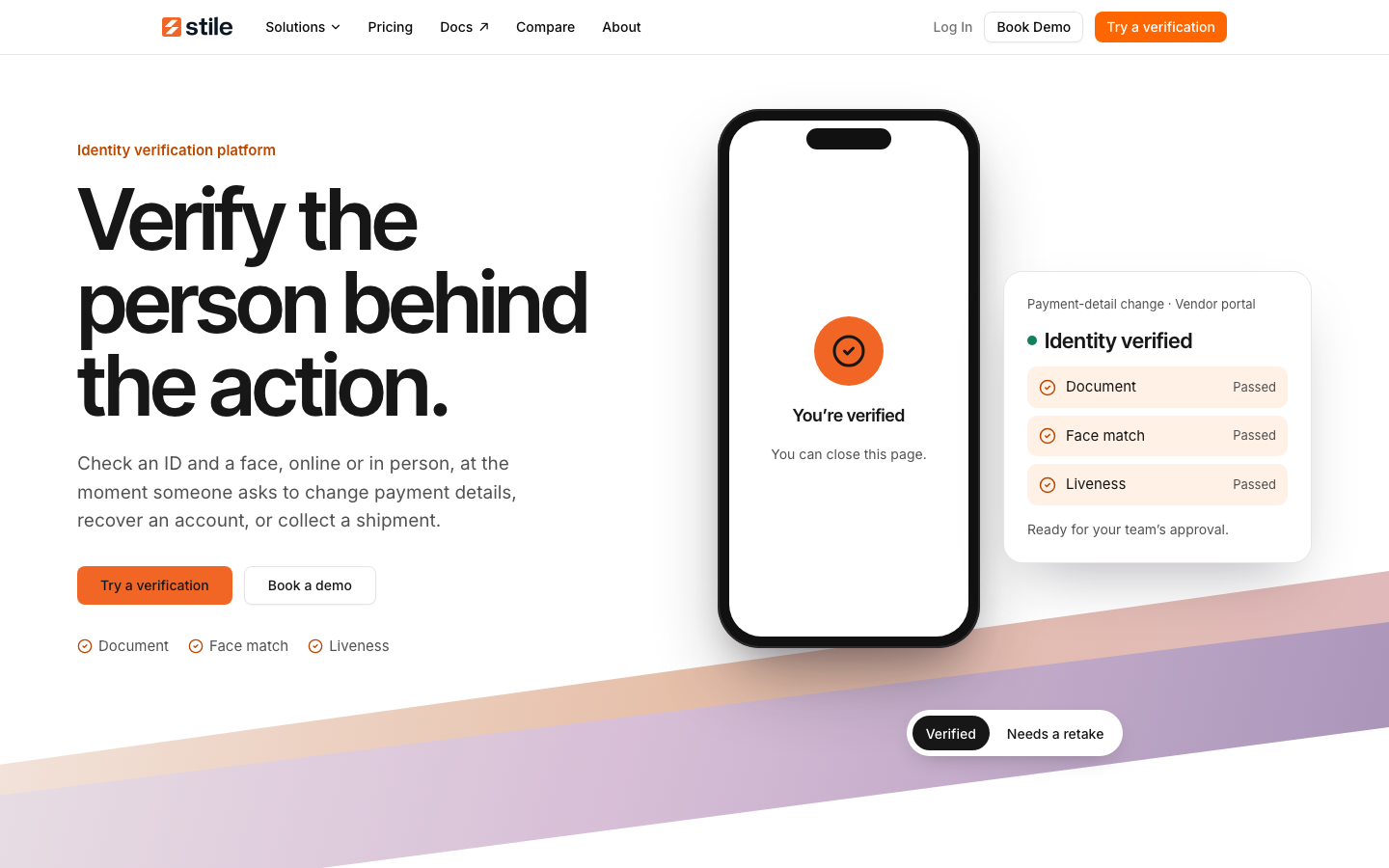
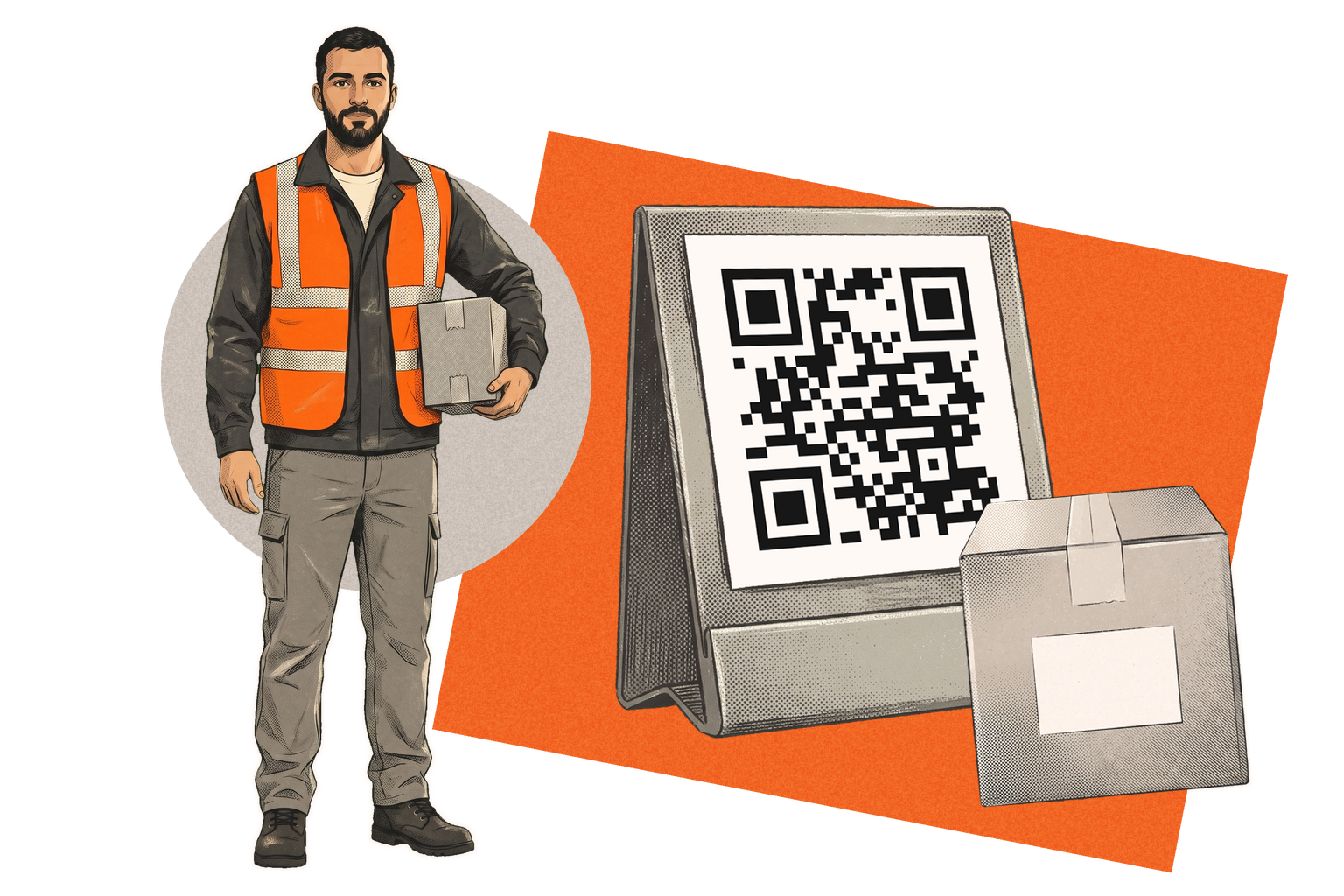
Stile is built for the moment of action rather than the front door. A check is triggered by an API call, a shared link or a QR code and opens in the user's browser, with no app to install. It takes about two seconds.
What a full check covers. Document capture, liveness detection, face match, age checks, and mobile driver's licenses and Apple or Google Wallet IDs. You choose which ones a workflow needs.
Online and in person
The same check works online, when a seller requests a payout change, and in person, when a customer scans a QR code at a pickup counter.
What comes back
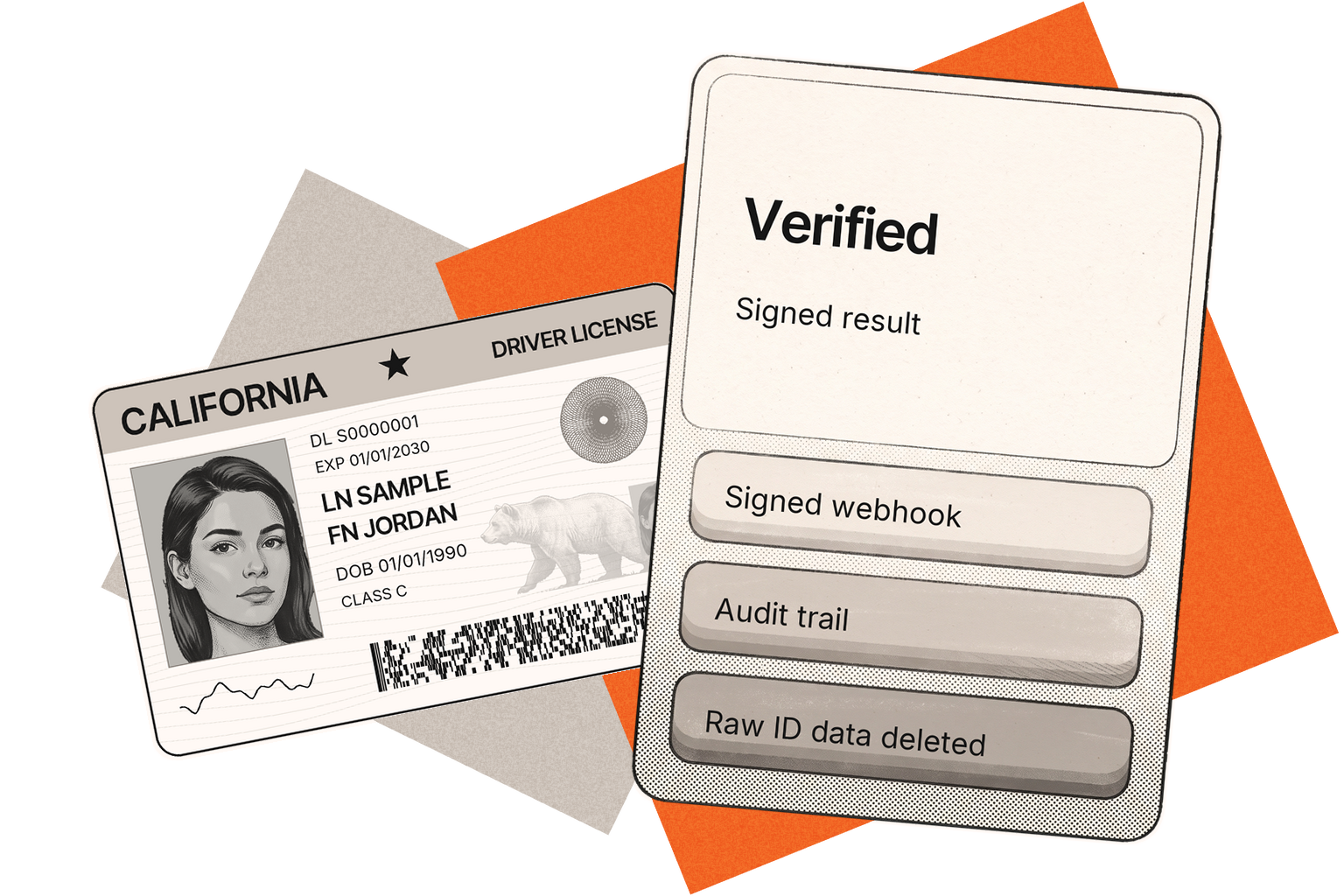
A signed webhook with an audit trail, not raw identity files. Raw ID data is deleted on completion by default, so your system can prove a check happened without holding the document. Stile's security and data handling page covers how that works.
Where Stile fits
Where it fits
Payment-detail changes, account recovery, age-restricted checkout or pickup, high-value pickups, and carrier or vendor onboarding in logistics. Stile's page on identity fraud protection for high-risk actions walks through those workflows.
Alongside what you have
Stile does not ask you to replace your onboarding, compliance or fraud stack. The signed result goes to whatever system already makes the decision. If Persona or another vendor handles onboarding well, it can keep doing so. A no-code dashboard adds a drag-and-drop workflow builder, jurisdiction rules, live sessions and audit log export for compliance teams.
How it works
Adding it in three steps
Trigger a check
From your backend with an API call, or send the user a link or show a QR code.
The user completes it
In the browser on their phone, with nothing to install.
Your system gets a signed webhook
With the result and the audit trail, and decides what happens next.
Pricing. Usage-based, so you pay for checks you run, not a commitment sized to a guess about how often payment changes happen. A free account gives you an API key in minutes. The pricing page lists the current rates per check.
For a head-to-head on Persona specifically, see the Stile vs Persona comparison.
The pick
| If you need | Pick |
|---|---|
| Global KYC and KYB with deep data coverage under one contract | Trulioo |
| High-volume identity verification with reusable identity for returning users | Jumio |
| A financial institution orchestrating many data vendors into one decision engine | Alloy |
| Face-based liveness and authentication in regulated or government settings | iProov |
| Biometric access control at physical locations you operate | Iris ID |
| Verifying the person at a payment change, recovery request or pickup, without replacing your onboarding vendor | Stile |
Most teams leaving Persona over onboarding problems will shortlist Trulioo, Jumio or Alloy. If the trouble starts after signup, the onboarding vendor is not the problem. The missing piece is a check at the risky moment.
No. If onboarding works, keep it. Add a check at the specific actions where fraud happens, such as payout changes, recovery and pickups, and send the result into the system that already decides.
Stile's checks open in the user's browser from a link, an API-triggered session or a QR code. For other vendors, ask in the demo whether the user flow needs your native app or an SDK built into it.
Trulioo lists business verification and UBO discovery. Alloy lists KYC/KYB within its compliance use cases. Test KYB depth against the entity types you onboard most.
European Tech Map's list of European Persona alternatives filters providers by deployment model and data residency. Confirm residency with any vendor in writing before you sign.
Ask what the vendor returns. A signed result with an audit trail proves the check happened. Stored document images are data you must secure, retain and eventually delete, and they become a target if your systems are breached.
That depends on the start path. Trulioo, Jumio, Alloy, iProov and Iris ID route buyers to a demo, sales or contact form. Stile gives you an API key from a free account.
Run your first check
If your risk sits at payment changes, account recovery or pickups, test a check at that exact step. Create a free Stile account, trigger a check by link or API, and watch the signed webhook arrive.