

How Do ID Scanners Work? Scanning vs. Identity Verification
An ID scanner can read a barcode or printed text, but a successful read is not identity verification. Learn what scanners check and what to ask first.
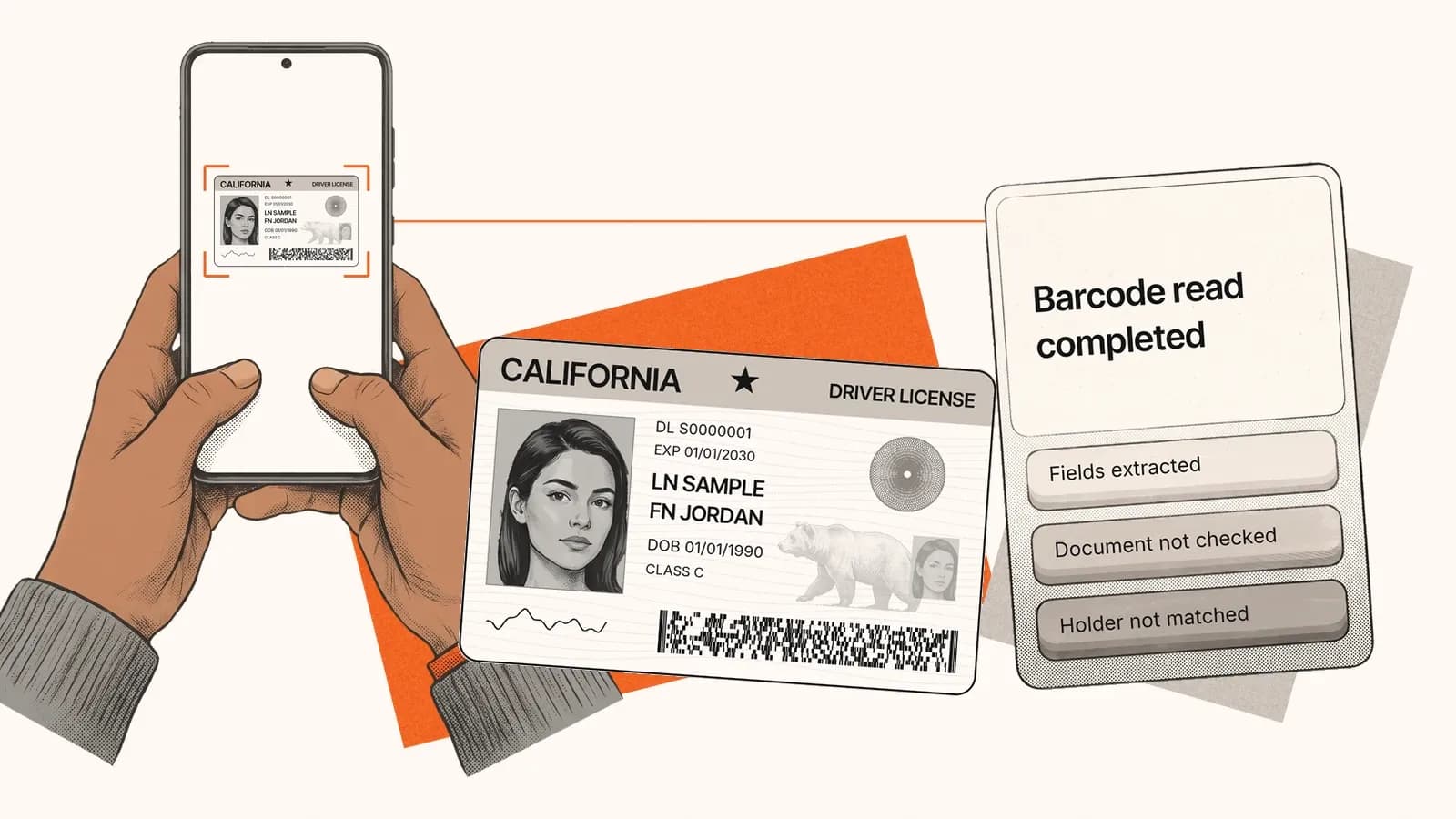
An ID scan can read information from a document. Depending on the system, it may also check formatting, consistency, or security features. Reading a barcode by itself does not establish that the document is genuine or that the presenter is its rightful holder.
Before relying on a scan, ask what the result actually means. That answer determines where the tool belongs in your workflow.
How an ID scanner reads a document
An ID scanner turns information on a card into fields that software can use. The exact steps depend on the reader and document:
- Capture the document. A camera or dedicated reader captures the printed side, barcode, or both. Glare, cropping, damage, and poor focus can make the capture unreadable.
- Decode or recognize the information. A barcode decoder interprets the encoded fields. On US and Canadian driver's licenses, those fields usually sit in a PDF417 barcode on the back of the card. Optical character recognition, or OCR, recognizes printed characters in an image. These are different ways to extract data.
- Apply the configured checks. Software may check expected formats, read an expiration date, or compare barcode fields with printed fields. Those checks can flag inconsistencies, but agreement between fields alone does not prove legitimate issuance. A few issuers now sign the barcode data: California's driver's license digital signature lets software confirm that selected barcode fields came from the DMV, though it does not cover the printed text or portrait.
- Perform additional verification where included. Document-authenticity checks, a comparison to the presenter, and liveness require more than decoding a barcode. Ask which of these the product actually performs.
The information read and the result returned to your application can differ. A provider may read fields to complete a check while returning only a result and reference. Ask separately what is extracted, what your team receives, and what each party retains.
“Scan” describes several different jobs
A venue might use a reader to populate a visitor record. A rental business might inspect document features. An online service might combine document validation, face matching, and liveness. All three could describe the process as scanning an ID, even though the evidence behind the result differs.
NIST's identity-proofing guidance separates evidence validation, attribute validation, and verification of the person's relationship to the evidence. That distinction is useful when evaluating products, even when your business is not implementing a NIST assurance level.
- Reading a barcode or printed text. Useful for extracting fields and reducing manual entry. Still to resolve: was the document legitimately issued?
- Checking document features and consistency. Useful for evaluating evidence of authenticity or alteration. Still to resolve: does it belong to this presenter?
- Checking selected attributes against a trusted source. Useful for testing whether those details agree with that source. Still to resolve: what fields and jurisdictions did the source cover?
- Comparing the presenter to the document portrait. Useful for connecting the person to the evidence. Still to resolve: was the capture trustworthy, and is the person authorized for this action?
A readable barcode answers a limited question
Imagine a hypothetical equipment-rental counter. A reader extracts a name and birth date and displays a green check. The clerk assumes the customer has passed identity verification.
If the system only decoded the barcode, that conclusion goes beyond the check. The display should explain whether it read data, validated the document, matched the holder, or completed some combination of those operations.
The opposite situation matters too. An unreadable barcode is an unresolved scan. It does not, on its own, justify accusing the customer of using a fake ID. Your procedure should distinguish capture problems from evidence that raises a fraud concern.
Match the check to the decision
For simple data entry, extraction may be enough. For a high-value release, account recovery, or a rental handoff, your team may need stronger evidence connecting the person to a trusted credential.
Work backward from the action. What loss could follow an incorrect approval? What would establish enough confidence? What should happen when the evidence remains uncertain? Answer those questions before comparing scanner features.
Identity verification also has a boundary: establishing who someone is does not establish their authority to act. A verified customer might still be collecting the wrong order or requesting access outside their role. Keep the identity result connected to the relevant account or transaction and apply your authorization rules separately.
Seven questions to ask a scanner or verification provider
- Does the product extract information, validate documents, verify people, or perform all three?
- Which document types, jurisdictions, and issuance versions does it support?
- What evidence supports each result, and what does an inconclusive result mean?
- Does any advertised database check use an authoritative source, and which fields does it confirm?
- How does the workflow connect the presenter to the document?
- What happens when capture fails, the network is unavailable, or a legitimate user needs another method?
- Which images and personal fields are retained, by whom, and for how long?
Ask to see ordinary failure cases during a demonstration. A worn document, an unsupported version, and a legitimate customer with a poor camera can reveal more about day-to-day operations than a flawless demonstration card.
Write result labels that staff can act on
Try replacing a generic “valid” label with a plain-language explanation. “Barcode read completed” and “identity check completed” should describe different results. A review state should tell the operator what remains unresolved and who handles it.
That small change can improve consistency across shifts. It also makes it easier to investigate a disputed decision without guessing what an old green icon represented.
Adding a person check
Stile brings document checks, liveness, and face matching into a single flow for identity verification. Liveness detection assesses whether the capture comes from a live person rather than a presentation such as a photo or replay. Face matching separately compares that person with the credential portrait.
Your business can use the result within its own approval process. For a broader introduction, read what identity verification involves.
A useful buying requirement is simple: every result should have a meaning your team can explain and a next action it can follow.
Source: NIST SP 800-63A-4, Identity Assurance Level Requirements. This article uses its distinctions as evaluation guidance and does not claim Stile certification or assurance-level conformance.
Common questions
What data does an ID scanner read?
Depending on the document and scanner, it can extract fields such as the name, date of birth, document number, expiration date, and address from printed text or a barcode. Not every credential contains the same fields, and not every product returns all the information it reads. Confirm the supported fields and retention policy before collecting them.
Can an ID scanner detect a fake ID?
Not by reading it alone. A successful read means the system could extract information. Establishing authenticity requires additional checks, and even a genuine document must be connected to its rightful holder when impersonation is part of the risk.
Does a scanner check a government database?
Only if that particular product and configuration include such a service. Ask for the source, coverage, permitted use, and exact fields checked.
Can a genuine ID belong to the wrong person?
Yes. Assessing the document and connecting it to its presenter are separate tasks. Your workflow needs both when impersonation is part of the risk.
Share this article