

Freight Fraud: When a Real Carrier's Account Is in the Wrong Hands
The carrier checks out. Who actually changed the driver, and is that the person at the dock? Four questions for brokers and warehouses to answer before a load is released, and what two recent cases show about why they matter.
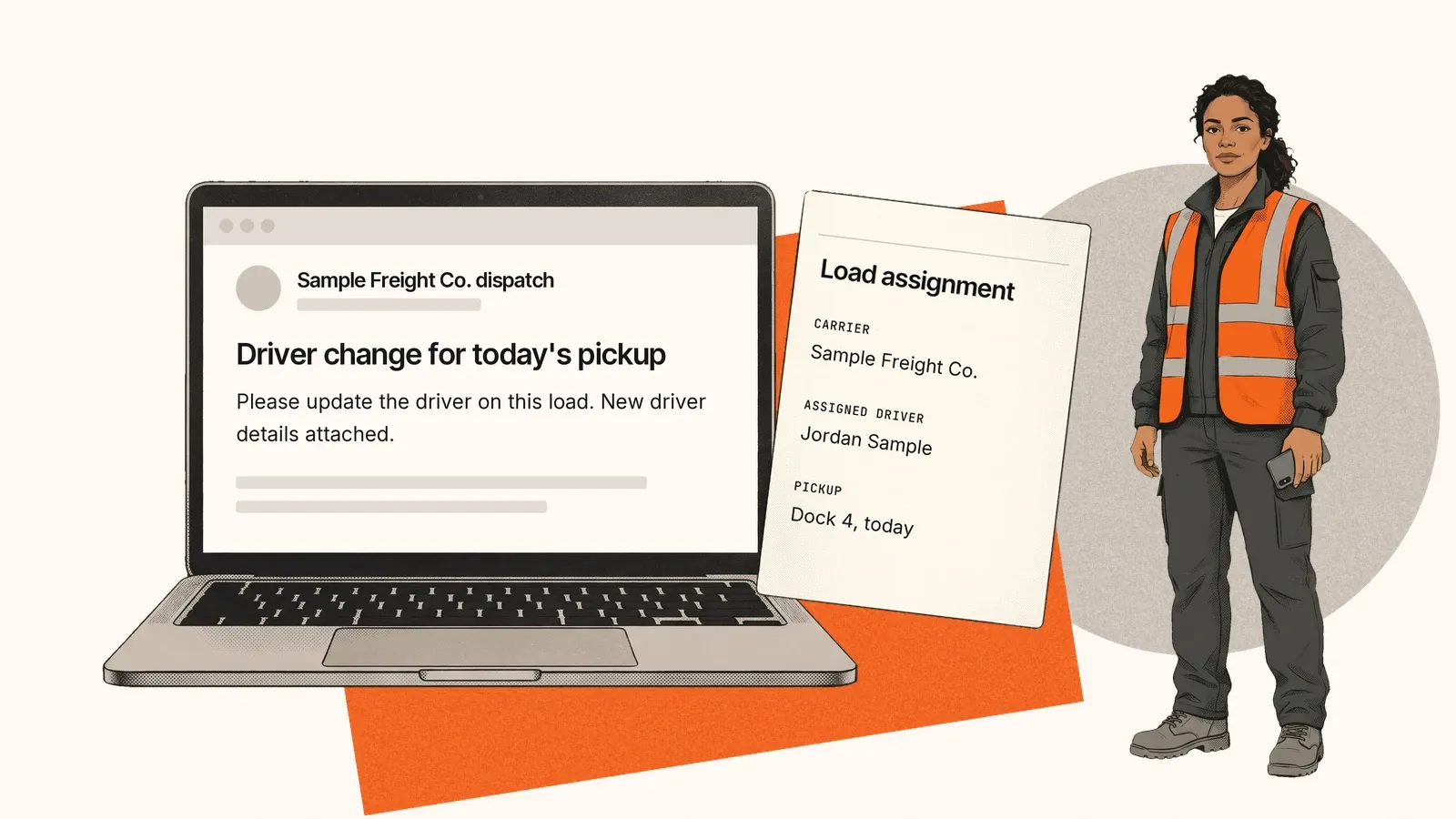
The carrier checks out. Its authority is active, its insurance is on file, and it has hauled for you before. Then the driver on a tendered load changes by email an hour before pickup. Who actually made that change, and is that the person now standing at the dock?
Most carrier vetting answers a different question: is this company real? That check still matters. It does not tell a broker who is acting in the carrier's name today, or tell a warehouse who should leave with the freight. Two developments from November 2026 show why, and they point to the same four questions.
Four questions to answer before a load is released
- Who is requesting access to shipment information? A request for a rate confirmation, pickup number or appointment detail should be tied to a known person at the carrier, not only to an email address.
- Is that person authorized to act for the carrier? Keep a record of who at each carrier may accept loads, change drivers or update banking details. Confirm changes through a contact method you already had on file, not one supplied in the request.
- Which driver is assigned to this particular load? Record the driver against the load before pickup. A change of driver is a new assignment and should be approved as one.
- Does the person arriving at pickup match that assignment? The dock needs a way to compare the person in front of them with the driver on the load. Our guide to verifying who is collecting a load covers that step in detail.
The first two questions belong to the broker's records. The last two connect those records to a person. All four apply whether the risk is a compromised account, an impersonator, or a double brokering scheme in which the load is quietly handed to a carrier nobody vetted.
Why a carrier that checks out can still be the wrong party
A made-up carrier has gaps: a new authority, a mismatched phone number, an email domain registered last week. A real carrier whose accounts are in someone else's hands has none of them. The authority is real, the insurance is real, and the email thread may include months of genuine history.
Consider a hypothetical load. An approved carrier asks a broker for a rate confirmation. The request comes from the usual address. An hour later the same address sends a new driver name and a changed pickup time. The warehouse receives an assignment that matches the load number, the carrier name and the trailer type.
Nothing in that sequence fails a company-level check. If the carrier's mailbox is controlled by someone else, the broker has confirmed a load with that person, and the warehouse is about to release freight to a driver the real carrier never sent.
What the research shows: carrier access can be taken over
On November 17, 2026, the security firm ANY.RUN published an analysis of three campaigns aimed at US trucking and logistics companies. Each copies a routine step in freight operations:
- Fake carrier verification portals. Emails impersonating the Federal Motor Carrier Safety Administration include the recipient's real USDOT number and lead to pages that ask for personal details, a fleet fuel card login and the one-time code that follows it.
- Fake onboarding and freight paperwork. Onboarding pages, bills of lading and rate confirmation documents are used to install a backdoor on the recipient's computer.
- Fake load board portals. Pages imitating load boards, including DAT and TIMOCOM, install remote access software on a dispatch workstation.
ANY.RUN linked about 1,430 domains to the first campaign in 2026. That number counts attacker infrastructure, not victims.
Be precise about what this research establishes. It documents how access to a carrier's accounts and computers is taken. It does not document cargo thefts that followed. The link to a diverted load is a risk to plan for, not a finding in the report.
A separate case: real companies, real people, stolen freight
The second development is unrelated to the first and makes a different point. On November 17, 2026, the U.S. Attorney's Office for the Central District of California announced a sentence in a cargo theft case. As reported by FreightWaves and CDLLife, Paramvir Singh was sentenced to 30 months in federal prison and ordered to pay $2,210,055 in restitution after pleading guilty to conspiracy to commit theft from interstate or foreign shipments.
According to that reporting, the group found or bought trucking companies between September 2021 and March 2025, enrolled them with freight brokers and load boards, and won genuine shipping contracts. Drivers collected the freight and it was not delivered. Prosecutors attributed about $7.2 million in stolen merchandise to the conduct Singh admitted. Co-defendants are scheduled for trial in March 2027, so the allegations against them remain unproven.
No account was hijacked here. The companies existed and the people were real. That is the limit of any identity check: knowing who someone is does not tell you what they intend.
Where to add checks in the workflow
You do not need to verify everyone at every step. Add a check where an incorrect approval is expensive and hard to reverse.
- Carrier onboarding. Establish who the authorized contacts are while the relationship is new. This is the reference point for every later request, and it is the focus of vendor identity checks.
- Changes after tender. Treat a new driver, a new pickup time or new payment details as a high-risk change. The pattern is the same as in account takeover fraud: the request arrives through a trusted channel, so the channel cannot be the evidence.
- Release at the dock. Compare the arriving driver with the assignment before the trailer is loaded.
Decide in advance what happens when a check cannot be completed. A driver with a dead phone or a carrier contact who cannot be reached should lead to a defined fallback, not an improvised approval.
What identity checks do not solve
An identity check does not remove malware from a dispatch computer, and it will not stop an employee from typing a password into a convincing copy of a portal. Those risks belong to account security: phishing-resistant sign-in, endpoint monitoring, and confirming that a carrier or load board site is genuine before entering credentials.
Identity checks also do not replace vetting or shipment controls. As the sentencing shows, a verified person at a registered carrier can still divert a load.
Where Stile fits
Stile verifies the person. A broker or warehouse sends a link, and the person completes a document check, a liveness check and a face match in one hosted flow, or presents a mobile driver's license. Your system receives a signed result.
Your records establish the rest. Whether that person is an authorized contact for the carrier, and whether they are the driver assigned to this load, comes from what you recorded at onboarding and at tender. Attaching the signed result to the carrier contact, the load or the pickup lets brokers and other logistics teams answer the four questions with evidence. For background on the checks themselves, see identity verification software.
Sources: ANY.RUN, "Fake FMCSA, DAT, and TIMOCOM Portals: 3 Cyberattacks Targeting US Logistics," November 17, 2026. U.S. Attorney's Office for the Central District of California, sentencing announcement, November 17, 2026, with details as reported by FreightWaves and CDLLife. This article is general information, not legal or security advice.
Common questions
What is freight fraud?
Freight fraud is a broad term for schemes that use deception to steal cargo or payments in the shipping process. It includes impersonating a carrier, taking over a real carrier's accounts, double brokering, and collecting a load with no intention of delivering it.
How do fake carrier portals lead to cargo theft?
A fake portal can capture a carrier's logins and one-time codes, or install remote access software on a dispatch computer. Whoever holds that access can read and send messages as the carrier. The research describes the access, not the thefts that may follow, so treat the link to cargo theft as a risk to plan for.
Does identity verification stop phishing or malware?
No. Identity verification does not remove malware from a computer or stop someone from entering a password on a fake site. It answers a different question: whether the person making a request or arriving at a dock is who the assignment says they should be.
If a carrier is real and verified, is the load safe?
Not necessarily. In a federal case sentenced in November 2026, the group used trucking companies it had found or bought to win genuine shipping contracts. Verification establishes who a person is. Your vetting, authorization rules and shipment controls still have to address whether they can be trusted with the load.
Share this article