

Fake Job Applicants: How to Verify Who Gets Hired and Given Access
Fake job applicants may use stolen identities or stand-ins. Learn where employers can verify the person before issuing equipment, credentials, or access.
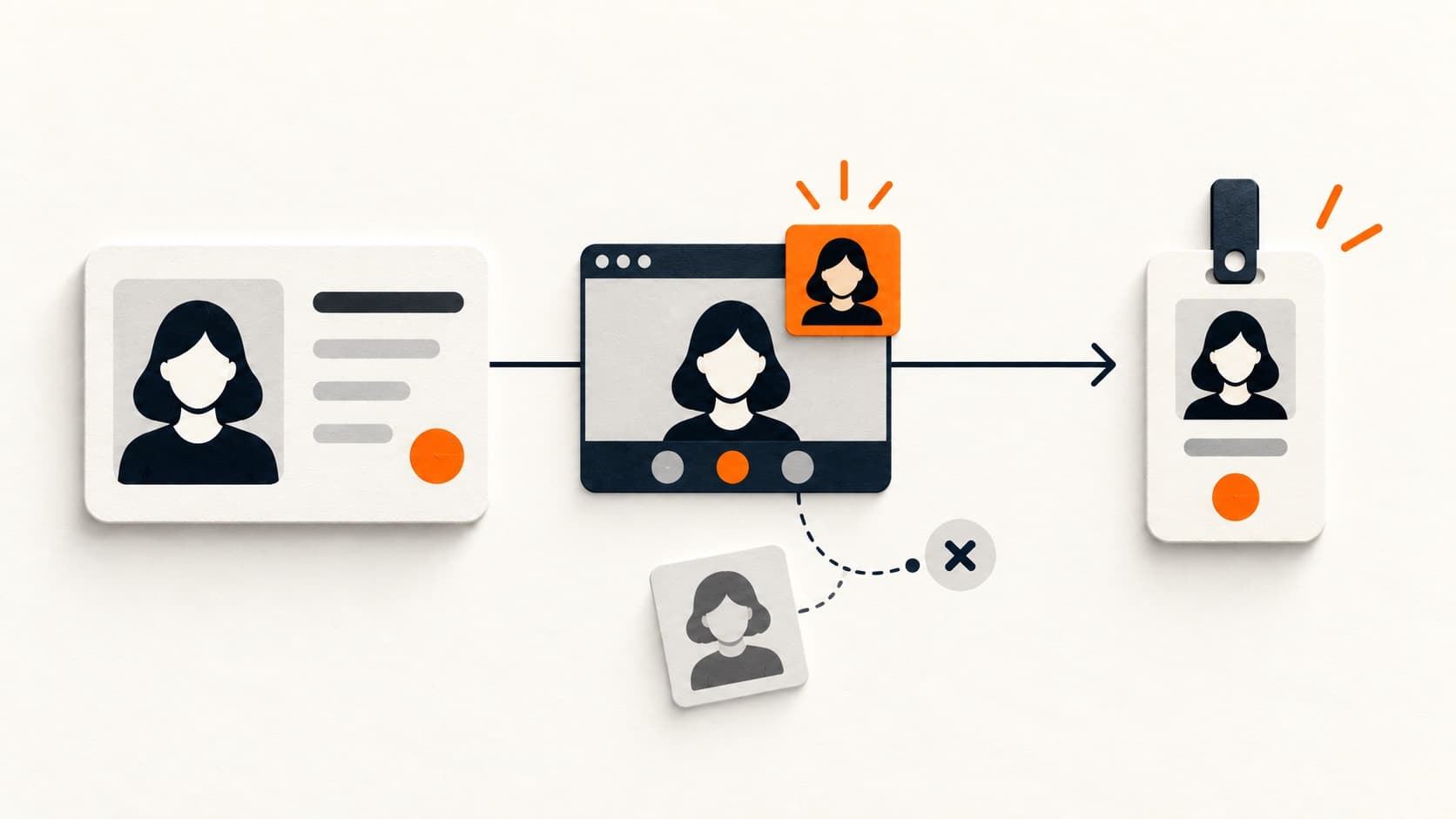
The person who interviews may not be the person who receives a laptop or logs in on day one. In some remote-hiring schemes, applicants use false identities or stand-ins to get through interviews, onboarding, and access approval. For employers, the critical question is not only whether a candidate looks credible. It is whether the person at each handoff matches the person in the hiring record.
Identity verification can help answer that question before credentials, equipment, or sensitive access are issued. It does not replace hiring judgment, a background check, or employment-eligibility procedures.
What are fake job applicants?
Fake job applicants misrepresent who they are in the hiring process. They may use stolen personal information, present a forged or altered document, or have someone else interview or work under the applicant's name. This is different from a fake recruiter or job posting that targets job seekers.
The risk is not unique to remote work, and remote candidates should not be treated as inherently suspicious. Apply a consistent, disclosed process to comparable roles, especially where a worker will receive access to systems, sensitive data, or funds.
How an applicant can pass one check and fail the next
In a July 2025 advisory, the FBI described North Korean IT worker schemes involving U.S.-based facilitators who received company laptops, enabled remote access, and attended virtual interviews or meetings on workers' behalf. The FBI noted that someone may pass the initial interview while another person later performs the work.
That is a documented threat pattern, not a description of every fraudulent applicant. It shows why isolated checks leave gaps: a resume, video call, identity document, payroll detail, and shipping address may each appear plausible. The employer needs a way to connect the person presenting identity evidence to the candidate record and to the access being granted.
Identity verification is not a background check
A background check examines information relevant to the role under the employer's screening process. Identity verification checks evidence that the person presenting an identity is the person it refers to. A match does not establish qualifications, work authorization, or that the same person will use the account indefinitely.
The FBI recommends identity-verification processes during interviewing, onboarding, and throughout employment for remote workers. It has also observed the use of AI and face-swapping technology during some video interviews. A video call can contribute context, but it should not be the only identity control.
Where to verify identity in the hiring workflow
Place checks where an identity decision changes what someone can do:
- Before a consequential hiring decision: verify the candidate through a consistent, disclosed process when the role's risk warrants it. Keep any background screening in its separate process, with applicable notices, consent, and review handled by the employer and its advisers.
- Before onboarding and equipment shipment: confirm that the person completing onboarding is the verified candidate. Reconcile the candidate record and review changes to the delivery address before sending a device.
- Before credentials or privileged access: tie the verification result to the worker record and the specific access request. Include contractors and vendor-supplied workers where they receive company or site access.
- When a high-risk detail changes: review a new shipping address, payment destination, or account-recovery request through a trusted channel. Re-verify when the change warrants it rather than treating an earlier check as permanent proof.
Offer a documented manual route when a supported credential or device is unavailable. Collect and retain only what the employer needs for the decision, consistent with its policies and applicable law.
Red flags are reasons to review, not reasons to reject
The FBI's business guidance calls out document and contact-detail inconsistencies, different equipment-shipping addresses, and concerning payment-account patterns. Its earlier advisory describes reused phone numbers or email addresses across purportedly different applicants and changes to addresses or payment platforms during onboarding.
None of these signals proves fraud by itself. Check the underlying record, contact the candidate through a known channel, give them an opportunity to resolve a discrepancy, and document the outcome. Keep identity verification distinct from immigration, Form I-9, E-Verify, and any other work-authorization requirements that apply.
Put identity evidence in the case that grants access
An employer can start a verification session from a hiring or HR case and invite the candidate or worker to present a supported mobile driver's license or physical identity document, with a live face check where appropriate. Stile's workforce identity verification flow supports verification links and a signed result that can be returned to the initiating record. The employer uses that result alongside its own candidate record to decide whether to proceed, seek more information, or escalate.
Stile provides identity-verification infrastructure, not a hiring verdict. The employer remains responsible for matching the result to the right person and case, setting hiring and access rules, and running any required background or work-authorization process.
Verify the person before you issue access. Explore Stile's workforce identity verification.
Frequently asked questions
How can employers spot fake job applicants?
Use consistent checks that connect identity evidence to the candidate record at the points where equipment, credentials, or access are issued. Investigate meaningful mismatches through a trusted channel instead of treating a single red flag as a verdict.
Is a video interview enough to verify identity?
No. A conversation does not validate an identity document or prove that the same person will later use the account. The FBI has documented interview stand-ins and face-swapping in specific remote IT worker schemes.
When should a candidate be re-verified?
Consider re-verification when a new person appears at onboarding, before sensitive access is granted, or after a material change such as an account-recovery or delivery-address request. Set thresholds based on role and risk, and provide a fair manual-review path.
Does identity verification replace a background check or E-Verify?
No. These answer different questions. Identity verification assesses evidence about the person presenting it; background screening, employment eligibility, and access approval remain separate processes with their own requirements and decision-makers.
Share this article